High-Frequency Trading in FX Markets has become an important subject for anyone studying modern foreign-exchange market structure. Currency trading is no longer dominated exclusively by telephone dealing, manual quotations and human execution decisions. Electronic platforms, automated liquidity providers and sophisticated trading algorithms now play substantial roles in how currency prices are discovered and transactions are completed.
High-frequency trading, commonly abbreviated as HFT, represents a specialised segment of this electronic trading environment. It typically involves automated decision-making, very short holding periods, rapid order submission and cancellation, and extensive investment in technology designed to minimise delays.
However, high-frequency trading is not a single strategy. It encompasses different business models, including electronic market making, short-horizon statistical arbitrage and strategies that respond to rapidly changing order-book information.
For retail traders, the purpose of studying HFT should not be to assume that an ordinary trading robot can compete directly with institutional systems. Instead, understanding HFT can explain important features of the Forex market: spreads, liquidity, execution costs, price fragmentation, adverse selection and sudden changes in trading conditions.
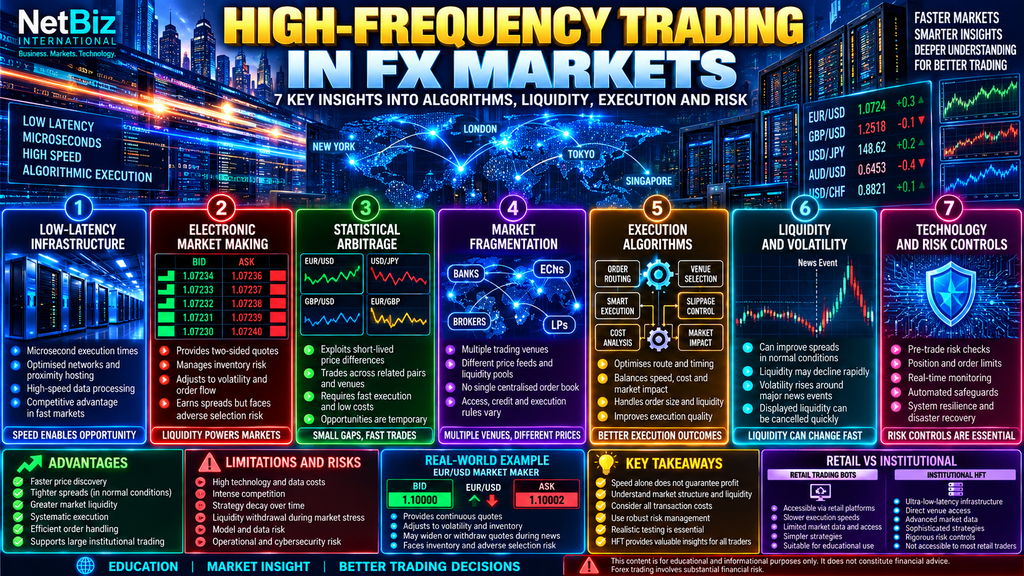
This guide examines seven essential insights into high-frequency trading in foreign-exchange markets, explains the underlying technology and evaluates its advantages, limitations and risks.
What Is High-Frequency Trading in FX Markets?
High-frequency trading is a form of algorithmic trading that relies on automated systems operating at very short decision and execution timescales. Depending on the strategy and trading venue, relevant delays may be measured in milliseconds or microseconds.
An HFT system can receive market data, evaluate a trading condition, calculate a quotation or order instruction and transmit that instruction electronically without requiring a person to approve every transaction.
The precise definition of HFT varies across research and regulatory contexts. Common characteristics include sophisticated technology, automated order generation, high message activity, short position-holding periods and close attention to execution latency.
Importantly, not every automated trading strategy is high-frequency trading. A system that checks currency prices every hour and enters a few trades each week is algorithmic, but it would not ordinarily be classified as HFT.
HFT Versus Conventional Algorithmic Trading
Algorithmic trading is the broader category. It includes trend-following systems, portfolio rebalancing, execution scheduling, statistical models and automated hedging.
HFT is a narrower category in which the speed of processing and interaction with electronic markets is particularly important.
A conventional execution algorithm might divide a large institutional order into smaller transactions over several minutes. An HFT market maker might update quotations repeatedly as market conditions change.
Both are automated, but they have different objectives, operating timescales and infrastructure requirements.
Why High-Frequency Trading in FX Markets Matters
The foreign-exchange market is one of the world’s largest financial markets, with activity distributed across banks, non-bank liquidity providers, electronic trading platforms, brokers and institutional investors.
Unlike a single centralised stock exchange, the global spot Forex market is predominantly over the counter. Transactions take place through different relationships and venues, and not every participant sees the same executable prices or available liquidity.
Electronic trading has increased the speed at which prices are distributed and orders are executed. Automated market makers compete to provide quotations, while sophisticated participants analyse short-lived pricing differences and changes in liquidity.
This competition can improve pricing efficiency and reduce some transaction costs under normal market conditions. Nevertheless, the benefits are not uniform across currencies, participants or periods of volatility.
Understanding these differences requires studying market microstructure, including order flow, quotation behaviour and execution mechanisms.
Research from the Bank for International Settlements provides important institutional background on global foreign-exchange trading, electronic market structure and the changing roles of liquidity providers.
Seven Powerful Insights Into High-Frequency Trading in FX Markets
1. Low-Latency Infrastructure Is a Core Requirement
Latency refers to the delay between an event occurring and a system receiving, processing or acting upon that event.
In high-frequency trading, latency can arise from network transmission, market-data distribution, software processing, operating-system scheduling, risk checks and order-routing arrangements.
Professional firms invest in optimised computing systems, fast network connections and carefully engineered software to reduce these delays.
Some firms locate equipment near the infrastructure used by trading venues or liquidity providers. This arrangement, commonly called colocation or proximity hosting, can reduce the physical distance that market data and orders must travel.
However, lower latency is not automatically profitable. A faster system that makes poor decisions or incurs excessive transaction costs can still lose money.
Moreover, the economic value of a small latency improvement depends on the strategy. A market maker responding to rapidly changing quotes may benefit more than a medium-term trader following daily economic trends.
2. Electronic Market Making Supplies Two-Sided Quotations
Market makers seek to facilitate trading by providing bid prices at which they are willing to buy and ask prices at which they are willing to sell.
The difference between these quotations is the bid-ask spread. A market maker may earn spread-related revenue, but that revenue is not guaranteed profit.
When a market maker buys a currency, it acquires inventory exposure. If the market subsequently moves against that position, the resulting loss can exceed the spread earned.
High-frequency market makers use algorithms to adjust quotations according to market volatility, inventory, available liquidity and the risk that another participant possesses more timely information.
This last concern is known as adverse selection. A market maker may be particularly vulnerable when its quotation becomes stale immediately before an important price change.
Automated systems therefore attempt to balance competitive pricing with protection against inventory losses and informed order flow.
3. Statistical Arbitrage Targets Short-Lived Relationships
Statistical arbitrage refers to strategies that use quantitative models to identify pricing relationships that may temporarily deviate from their expected behaviour.
In foreign exchange, a strategy might compare related currency instruments, trading venues or spot and derivative prices.
For example, triangular relationships among currency pairs can create apparent pricing discrepancies. In an idealised example, EUR/USD, USD/JPY and EUR/JPY should be mutually consistent after accounting for their quotation conventions.
However, an apparent discrepancy is not necessarily an executable arbitrage opportunity.
Real-world execution requires accounting for bid-ask spreads, transaction fees, market depth, settlement arrangements, credit relationships and the possibility that a quoted price changes before all transactions are completed.
By the time a retail trader observes a pricing inconsistency, professional systems may already have responded.
Successful quantitative trading therefore requires more than identifying mathematical differences. It requires a realistic model of transaction costs, execution probability and operational risk.
4. Forex Market Fragmentation Creates Different Price Views
Global Forex trading is fragmented across numerous execution channels.
These include interdealer platforms, bank-to-client systems, multi-dealer platforms, prime-brokerage arrangements and other electronic liquidity networks.
As a result, there is no universally visible consolidated spot Forex order book covering every transaction and quotation.
Different participants may encounter different prices because of venue access, credit limits, available liquidity, execution rules and trading relationships.
High-frequency firms operating across multiple venues must account for these differences when evaluating opportunities.
A quotation visible on one platform may not be accessible to every participant. Even when two prices appear different, they may not be directly comparable because the associated trading conditions differ.
This is one reason why analysing institutional order flow requires an understanding of market access and execution structure rather than relying solely on retail chart data.
5. Execution Algorithms Must Account for Costs and Market Impact
High-frequency systems do not operate in a frictionless market.
Every trading decision must consider direct transaction fees, bid-ask spreads, slippage, financing or funding arrangements where relevant, and the possibility of adverse price movement.
Market impact occurs when the execution of an order changes the price available for subsequent transactions.
For a large institutional order, immediate execution may consume available liquidity and worsen the average transaction price.
Execution algorithms can divide orders, select venues or adjust participation rates to balance speed against market impact.
These algorithms are not necessarily HFT strategies themselves. Some operate over longer periods, even when they use sophisticated electronic infrastructure.
Smart order routing can help identify available execution opportunities, but the optimal route depends on price, liquidity, credit arrangements, fees and the probability of successful completion.
The best quoted price is not always the best realised execution outcome.
6. HFT Can Influence Liquidity and Volatility
Electronic market makers may contribute to narrower spreads and faster price adjustment during normal trading conditions.
Competition among automated liquidity providers can also increase the frequency with which quotations respond to new information.
However, liquidity should not be confused with the number of orders displayed or messages transmitted.
Some displayed orders can be cancelled rapidly. A market may appear liquid until a significant event causes participants to withdraw or reprice their quotations.
During economic announcements, geopolitical events or abrupt market stress, liquidity providers may widen spreads and reduce available size to manage uncertainty.
Automated strategies can contribute to rapid price adjustment, but the effect of HFT on volatility depends on the specific strategy, venue and market conditions.
It would be inaccurate to claim that all high-frequency trading stabilises markets or that all HFT causes instability.
The more useful analytical question is how different trading strategies behave when volatility rises and liquidity becomes scarce.
7. Operational Risk Controls Are Essential
High-frequency trading creates substantial technological and operational demands.
A software defect, incorrect market-data feed, connectivity problem or faulty risk parameter can generate erroneous orders extremely quickly.
Professional trading systems therefore require multiple layers of safeguards.
Examples include maximum order sizes, position limits, price collars, message-rate controls, automated cancellation mechanisms, real-time exposure monitoring and emergency shutdown procedures.
Pre-trade risk checks help prevent unacceptable orders from reaching execution venues. Post-trade monitoring identifies exposures and system behaviour that require investigation.
Testing, change control, logging and incident response are also essential because an automated system can amplify mistakes before a human operator intervenes.
The Global Foreign Exchange Committee publishes the FX Global Code, which sets out principles of good practice for participants in the wholesale foreign-exchange market.
How High-Frequency FX Trading Systems Operate
Market-Data Collection
An automated system begins by receiving market information from its authorised data sources.
Depending on the venue and strategy, this may include bid and ask quotations, available order-book depth, trade reports, market status messages and relevant instrument data.
Data quality is critical. Delayed, incomplete or inconsistent information can produce incorrect trading decisions even when the strategy’s mathematical logic is sound.
Signal Processing and Decision Logic
The trading engine evaluates incoming information against its programmed rules.
A market-making model may calculate new bid and ask prices based on inventory and volatility. A statistical model may evaluate whether a price relationship has moved beyond a predefined threshold.
The model must account for the possibility that a detected opportunity disappears before execution.
Order Submission and Execution
Once the system decides to act, the proposed order passes through applicable risk controls and is transmitted to an execution venue.
The venue may accept, reject, partially execute or fully execute the instruction.
The trading system must correctly process every response. Assuming that an order has executed when it has not can create unexpected exposure.
Position Management and Monitoring
After execution, the system updates its inventory, realised and unrealised profit or loss, available limits and outstanding orders.
It may submit hedging transactions, modify quotations or stop trading if risk thresholds are reached.
Continuous monitoring is necessary because an automated system must remain safe even when market conditions depart from the assumptions used during development.
Practical Example: An Automated EUR/USD Market Maker
Consider a simplified hypothetical electronic market maker quoting EUR/USD.
The system receives an indicative bid of 1.10000 and ask of 1.10002. The two-pipette difference represents a spread of 0.00002, equivalent to 0.2 pip for EUR/USD.
These numbers are illustrative, not current executable market quotations.
The system may attempt to provide competitive prices while controlling its net EUR exposure.
If it buys EUR from a customer, its inventory increases. The system may then adjust its quotations to encourage offsetting transactions or hedge the exposure elsewhere.
Suppose important economic news arrives and the market moves rapidly. Existing quotations can become stale, and the system may face losses if it continues to trade at prices that no longer reflect current conditions.
A well-designed strategy therefore monitors volatility, quote age, inventory limits and market-data quality.
It may temporarily widen quotations or withdraw them when uncertainty exceeds its operating thresholds.
This example demonstrates why the apparent spread between a bid and ask is not equivalent to guaranteed trading profit.
HFT Versus Retail Forex Trading Bots
Retail traders often use expert advisors, automated strategies and broker APIs to execute rules-based transactions.
These systems can be valuable for consistent execution, testing and strategy automation. However, they should not automatically be described as institutional high-frequency trading.
Retail platforms commonly operate through broker-specific execution arrangements, with network delays, spreads, trading restrictions and order-handling conditions that differ from institutional venue access.
A strategy that appears profitable when backtested against historical mid-prices may become unprofitable after realistic spreads, slippage and commissions are included.
Retail traders should therefore prioritise reliable execution, robust testing and realistic expectations rather than attempting to achieve microsecond-level trading speeds without suitable infrastructure.
For related educational examples, see the NetBiz discussion of a triple moving average crossover expert advisor and an automated divergence and convergence strategy.
Advantages of High-Frequency Trading in FX Markets
Potential advantages include rapid processing of market information, systematic execution, automated inventory management and efficient quotation updates.
High-frequency market making can contribute to price competition and liquidity provision when market conditions support profitable two-sided trading.
Automation can also reduce some forms of human execution delay and improve consistency in applying predefined trading rules.
For institutional firms, sophisticated monitoring and execution technology can support large-scale activity across multiple venues.
However, these advantages depend on implementation quality, market access, strategy design and the prevailing trading environment.
Limitations and Risks of High-Frequency FX Trading
Infrastructure and Development Costs
Professional HFT may require substantial expenditure on data, connectivity, computing infrastructure, specialist software and engineering expertise.
These costs must be justified by an expected trading advantage after transaction costs and operational expenses.
Competition and Strategy Decay
Short-lived pricing inefficiencies can disappear as competing firms adopt similar technology.
A strategy that worked under one market structure may stop performing when liquidity patterns, venue rules or competitor behaviour change.
Market Stress and Liquidity Withdrawal
During periods of extreme uncertainty, market makers may reduce exposure or withdraw quotations.
Participants relying on previously observed liquidity may discover that executable prices are significantly worse than expected.
Model and Data Risk
Faulty assumptions, inaccurate data, incorrect timestamps and unstable model parameters can generate misleading signals.
Historical simulation is particularly difficult when the strategy’s performance depends on queue position, rapidly changing order books or microsecond-level execution.
Operational and Cybersecurity Risk
Connectivity failures, software defects, compromised systems and inadequate controls can disrupt trading.
Because decisions occur automatically, small technical problems can become financially significant in a short period.
How to Evaluate an HFT Strategy
A rigorous assessment must begin with a clear explanation of the strategy’s economic rationale.
Does the system provide liquidity, exploit a statistical relationship, hedge an existing exposure or execute an institutional order?
Next, the analysis must incorporate realistic trading costs. These include spreads, fees, slippage, rejected orders and the costs associated with maintaining the necessary infrastructure.
Backtesting should use data appropriate to the strategy’s timescale. Daily or minute-level candles are generally insufficient for evaluating a strategy whose decisions depend on individual order-book events.
Testing should also consider execution uncertainty. A historical quotation does not prove that the strategy could have traded the required size at that price.
Out-of-sample evaluation, sensitivity testing, operational failure scenarios and conservative capacity assumptions are important.
Finally, performance should be evaluated through risk-adjusted measures, drawdowns, tail losses and stability across different market regimes rather than gross trading profits alone.
Risk Management for High-Frequency Trading in FX Markets
Risk management should be embedded directly into the trading architecture rather than added only after a strategy has been developed.
Pre-trade checks can restrict maximum order size, net exposure, permissible instruments and acceptable prices.
Real-time monitoring should track outstanding orders, executed positions, realised and unrealised losses, system latency and connectivity status.
Automated shutdown rules can stop new trading when specified limits are exceeded, although these controls must themselves be tested for reliability.
Operational procedures should address data-feed failure, duplicate messages, inconsistent order states, unexpected disconnections and recovery after an interruption.
Independent review and detailed audit logs are particularly important when algorithms operate faster than humans can observe individual decisions.
For discretionary traders, the practical lesson is similar: control leverage, understand execution conditions and avoid assuming that stop orders will always execute at the requested price.
Common Mistakes When Studying High-Frequency Trading
Believing That Faster Execution Guarantees Profit
Speed is only useful when it improves the execution of a sound strategy. Transaction costs and adverse selection can overwhelm any latency advantage.
Confusing Trading Volume With Available Liquidity
High message activity or transaction volume does not necessarily indicate that substantial liquidity will remain available during market stress.
Ignoring the Fragmented Nature of Spot Forex
Prices and liquidity visible on one platform do not represent the complete global currency market.
Using Unrealistic Backtesting Assumptions
Backtests that ignore spreads, queue position, execution delays and order rejection can materially overstate performance.
Assuming Every Automated Strategy Is HFT
Many useful algorithmic strategies operate on slower timescales and do not require institutional low-latency infrastructure.
How High-Frequency Trading Fits Into a Forex Trading Framework
High-frequency trading analysis provides context for both institutional and retail participants.
For institutional traders, it informs decisions about market access, execution quality, venue selection and liquidity provision.
For quantitative researchers, it highlights the importance of high-quality data, precise simulation and realistic transaction-cost modelling.
For retail traders, it explains why spreads and slippage vary, why apparent price discrepancies may be inaccessible and why sudden volatility can affect execution.
It also complements liquidity sweeps and stop hunts, although sudden price movements should not automatically be attributed to deliberate manipulation or HFT activity.
Understanding the interaction between algorithms, liquidity and market structure can improve the interpretation of price behaviour without requiring participation in high-frequency strategies.
The Future of High-Frequency Trading in FX Markets
The evolution of electronic Forex trading will continue to depend on technological innovation, changes in market access, liquidity-provider competition and institutional risk requirements.
Improvements in data processing, automated execution and quantitative modelling may influence how quickly markets respond to information.
At the same time, operational resilience, cybersecurity, responsible algorithmic behaviour and robust controls will remain important.
Artificial intelligence and machine learning may support selected trading and risk-management functions, but complex models introduce additional challenges involving explainability, stability and validation.
Not every technological improvement creates a sustainable trading advantage. Competition, costs and changing market structure can erode opportunities over time.
Conclusion: High-Frequency Trading in FX Markets
High-Frequency Trading in FX Markets is an important component of modern electronic currency trading, but it is best understood as a collection of specialised strategies rather than a universal formula for profitability.
The seven insights examined here—low-latency infrastructure, electronic market making, statistical arbitrage, market fragmentation, execution algorithms, liquidity dynamics and operational risk controls—explain how sophisticated automated participants interact with foreign-exchange markets.
HFT can contribute to efficient pricing and liquidity under suitable conditions, yet it also faces significant competition, technological costs, adverse selection and operational risks.
For most retail traders, the greatest benefit is educational. Understanding high-frequency market activity can improve awareness of spreads, slippage, execution quality and the limits of retail market data.
The central conclusion is straightforward: successful trading depends not merely on speed, but on sound economic logic, realistic costs, reliable infrastructure and disciplined risk management.
No responses yet