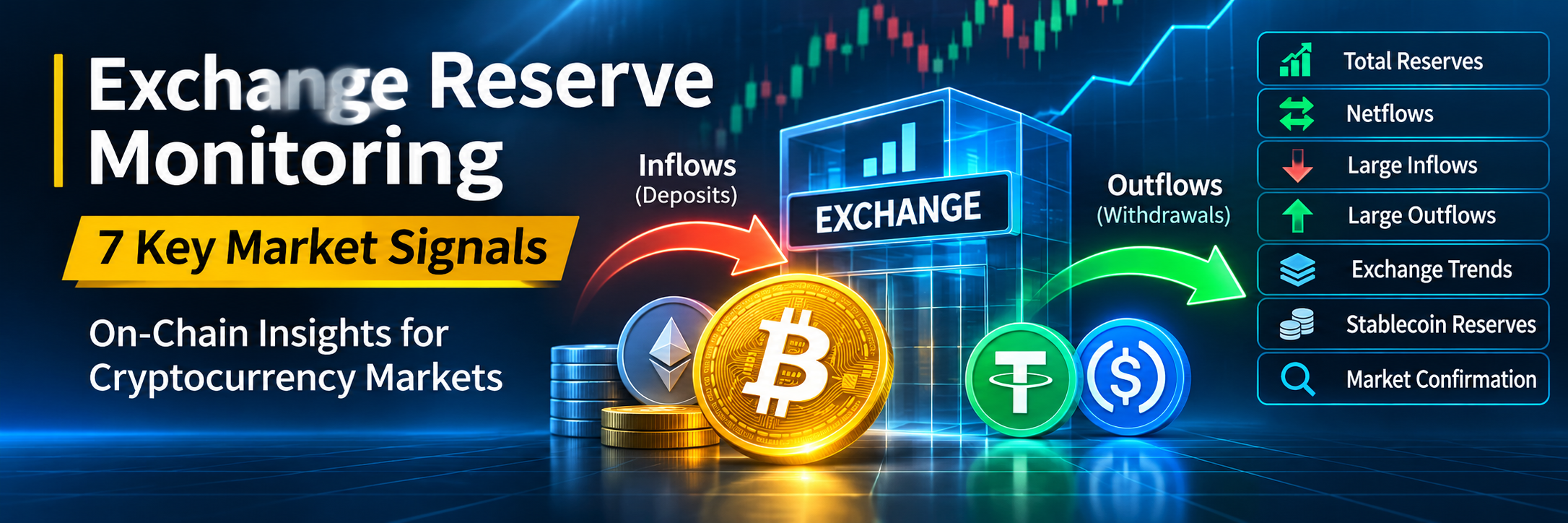
Exchange Reserve Monitoring is an on-chain analytical technique used to examine how much cryptocurrency is held at centralised exchanges, how those balances change, and what the movements might reveal about market conditions. For Bitcoin, Ethereum and other digital assets, changes in exchange reserves can provide useful context about potential trading supply, custody preferences and investor behaviour.
However, exchange reserves are not a direct measurement of future buying or selling. An exchange deposit may precede a sale, but it may also represent collateral management, market-making activity or a routine transfer. Similarly, a withdrawal may reflect long-term self-custody, institutional storage or an exchange reorganising its wallets.
This guide explains seven important exchange reserve indicators, how to interpret them, the limitations of blockchain data, and how to combine reserve monitoring with broader cryptocurrency market analysis.
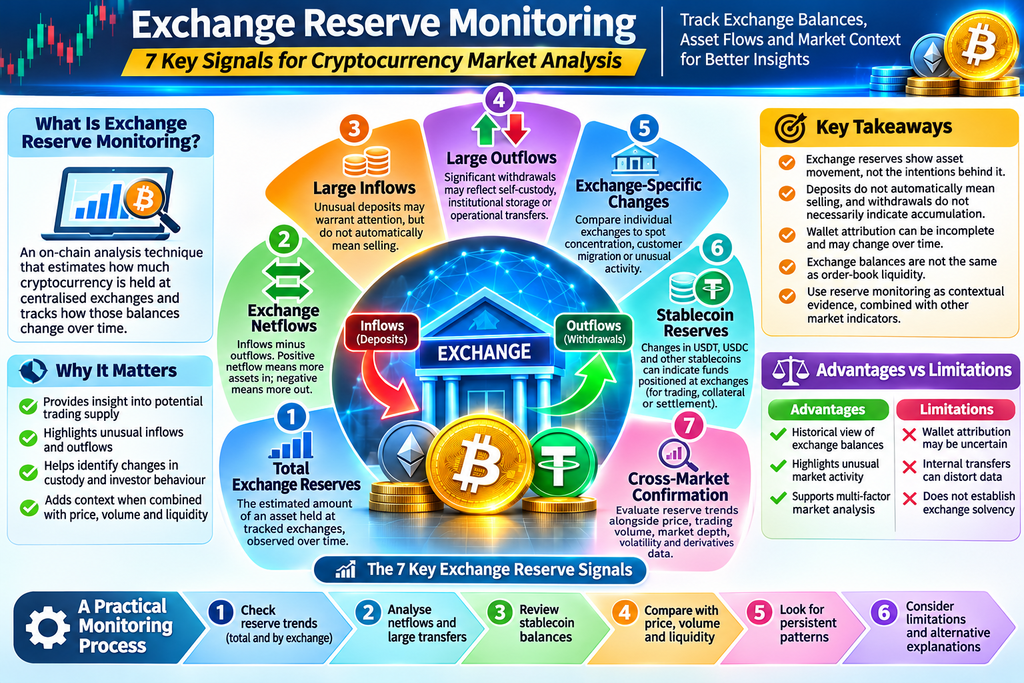
What Is Exchange Reserve Monitoring?
Exchange Reserve Monitoring involves estimating the quantity of cryptocurrency controlled by centralised trading platforms and observing how those balances change over time. Analysts use blockchain transactions, wallet attribution and historical balance records to identify potential shifts in assets held within exchange-controlled wallets.
For example, an analytics provider may identify a collection of Bitcoin addresses associated with an exchange. It can calculate the estimated BTC balance across those addresses and track transfers into and out of the identified cluster.
Because blockchain addresses do not necessarily disclose their real-world owners, the quality of the estimate depends on wallet identification, clustering methods and continuing updates to the address database.
The result is an estimate of exchange-controlled on-chain balances, not an independently audited statement of every asset or liability held by the exchange.
Exchange Reserves Versus Available Trading Liquidity
Exchange reserves should not be confused with the cryptocurrency available for immediate execution in an order book. A platform may control substantial Bitcoin reserves while displaying limited sell-side depth near the current market price.
Conversely, a market can exhibit significant order-book activity without a corresponding increase in visible exchange wallet balances.
For more information on this distinction, see our guide to Crypto Liquidity Analysis.
Why Exchange Reserve Monitoring Matters
Cryptocurrency markets operate continuously, and participants move assets between exchanges, personal wallets, institutional custodians, decentralised protocols and other venues. These transfers can alter the amount of cryptocurrency readily positioned at centralised trading platforms.
Monitoring reserves can help analysts investigate several questions:
- Are identified exchange balances increasing or decreasing over time?
- Are large transfers concentrated around periods of volatility?
- Are reserve movements widespread or limited to one exchange?
- Are cryptocurrency and stablecoin balances changing in different directions?
- Do observed movements coincide with changes in price, volume, derivatives positioning or liquidity?
The analytical value comes from comparing these observations rather than assuming that one transaction reveals the intentions of its sender.
Signal 1: Total Exchange Reserves
Total exchange reserves represent the estimated amount of a particular asset held across a selected group of centralised exchanges. Analysts frequently monitor Bitcoin and Ethereum reserves, although coverage varies across assets and providers.
Declining Exchange Reserves
A sustained decline in identified exchange balances may suggest that assets are moving away from centralised trading venues. One possible explanation is increased self-custody or longer-term holding.
Other explanations include institutional custody arrangements, migration to decentralised finance, exchange wallet restructuring, changes in address attribution, and transfers to services not included in the dataset.
Declining reserves are therefore sometimes described as a potentially constructive supply-side development, but they do not establish that prices must rise.
Increasing Exchange Reserves
An increase indicates that more of the tracked asset is present in identified exchange wallets. Some market participants interpret this as an expansion of assets potentially available for trading or selling.
Yet deposits can also support collateral requirements, arbitrage, market making, lending operations or other activities. A rising balance is not proof that the deposited assets will be sold.
Analysts should compare the magnitude and persistence of the change with historical ranges and the prevailing market environment.
Signal 2: Exchange Netflows
Exchange netflow is generally calculated as the value or quantity of assets flowing into tracked exchange addresses minus the amount flowing out during a defined period.
Netflow = Exchange Inflows − Exchange Outflows
A positive netflow indicates that measured inflows exceeded outflows. A negative netflow indicates that measured outflows exceeded inflows.
A Hypothetical Netflow Example
Suppose an exchange receives 12,000 BTC and sends 15,000 BTC out of its identified wallets during one day. The measured netflow would be −3,000 BTC.
That observation suggests a net movement away from the tracked wallet cluster. It does not, by itself, identify whether the transfers were customer withdrawals, internal operational movements or transfers to another custody provider.
For a useful interpretation, analysts need to consider how the data provider classifies internal transfers and whether the exchange’s wallet coverage is complete.
Why Netflows Can Be Misleading
A large exchange may reorganise funds between hot and cold wallets, producing substantial blockchain activity without changing its overall economic exposure. A provider that correctly identifies both sides of the movement may exclude it from customer-flow metrics; another provider may initially classify the transfer differently.
Netflow figures should therefore be read together with the methodology used to produce them.
Signal 3: Large Exchange Inflows
Large cryptocurrency transfers into exchange-controlled wallets attract attention because the transferred assets may be positioned for trading. This can be particularly relevant during sharp rallies, major news events or periods of heightened volatility.
Nevertheless, a single large deposit is not a reliable prediction of a market decline.
A substantial inflow might represent an institution transferring collateral, an arbitrage operation between trading venues, a custodian adjusting operational arrangements or an investor preparing to sell.
These explanations can have very different implications for price.
How to Evaluate an Inflow Spike
First, determine whether the inflow is unusually large compared with the asset’s historical activity. Second, establish whether the movement is concentrated at one exchange or spread across multiple venues.
Third, review market conditions: price direction, trading volume, order-book depth, volatility and relevant news. Finally, examine whether the flow persists beyond a single reporting interval.
Inflow spikes are best treated as investigation triggers rather than automatic bearish trading signals.
Signal 4: Large Exchange Outflows
Large outflows can be associated with customers moving assets to self-custody, institutional custody or other blockchain destinations. Some analysts interpret persistent outflows as a potential reduction in exchange-positioned supply.
But the destination matters. An outflow to another exchange, custodian or lending service may not reflect long-term accumulation. Likewise, exchange wallet migrations can create apparent outflows that do not correspond to customers removing assets from the platform.
Why Destination Analysis Is Important
On-chain analysts may examine destination clusters, transfer patterns, wallet histories and subsequent movements to better understand the transaction.
Even with these techniques, attribution remains probabilistic in many cases. A blockchain transaction can reveal where funds moved without establishing why the owner initiated the transfer.
This is especially important when interpreting large transactions by so-called crypto whales. A large transfer may be noteworthy without providing reliable evidence of the holder’s trading intention.
Signal 5: Exchange-Specific Reserve Changes
Aggregate reserves can conceal meaningful differences between individual platforms. One exchange may experience sustained inflows while another reports declining balances.
These differences can arise from customer preferences, product availability, regional restrictions, institutional relationships, fee structures, security concerns or changes in custody arrangements.
Analysts should compare exchange-specific reserves carefully because wallet coverage and operational models vary.
Exchange Concentration and Counterparty Risk
When substantial cryptocurrency balances are concentrated at a small number of custodial platforms, the market may become more sensitive to operational interruptions or exchange-specific problems.
Exchange reserve monitoring can contribute to a broader assessment of concentration, but it does not establish the financial health or solvency of an exchange.
A platform can hold substantial visible assets and still have undisclosed liabilities or other risks.
For additional context on centralised trading venues, read our guide to major cryptocurrency exchanges.
Signal 6: Stablecoin Exchange Reserves
Stablecoin reserves represent another dimension of exchange monitoring. Analysts may track the estimated balances of USDT, USDC and other stablecoins held at centralised platforms.
Increasing stablecoin balances can indicate that more stablecoin-denominated funds are positioned at tracked exchanges. In some circumstances, these funds may be available to support purchases of other crypto assets.
However, stablecoins are also used for collateral, settlement, transfers, hedging and other financial activities. Their presence on an exchange does not guarantee imminent buying demand.
Combining Stablecoin and Bitcoin Reserve Data
Consider a hypothetical market where Bitcoin reserves are gradually declining while stablecoin reserves are rising. One interpretation is that fewer BTC are held at exchanges while more stablecoin-denominated capital is positioned there.
This configuration may be worth investigating, but it cannot confirm a bullish outcome without supporting evidence from price, market depth, volume and actual trading activity.
Our article on Stablecoin Flows and Market Sentiment explains how stablecoin movements can contribute to market interpretation.
Signal 7: Cross-Market Confirmation
The strongest use of Exchange Reserve Monitoring is as one component of a broader analytical framework.
Reserve changes can be evaluated alongside spot trading volume, order-book liquidity, market depth, price structure, volatility, derivatives funding rates, open interest and broader market participation.
Reserves and Price Action
A reserve decline accompanied by improving market breadth and sustained buying activity may support a different interpretation from a reserve decline during a severe liquidity contraction.
Similarly, an inflow spike during a strong rally deserves different consideration from an inflow spike during an exchange-specific operational incident.
Context is essential because identical on-chain patterns can occur for different reasons.
Reserves and Bitcoin Dominance
Bitcoin reserve trends may also be studied alongside the relative performance of Bitcoin and alternative cryptocurrencies. Changes in Bitcoin dominance can provide information about market leadership, although they do not establish the cause of exchange balance movements.
See Bitcoin Dominance Explained for a complementary market-structure perspective.
A Practical Exchange Reserve Monitoring Example
Imagine a hypothetical four-week period in which tracked Bitcoin exchange reserves decline steadily. At the same time, spot trading volume increases, market depth improves and price rises gradually rather than through a single sharp spike.
An analyst might regard these conditions as consistent with sustained demand and a reduction in exchange-positioned BTC supply.
Now consider a different hypothetical situation: reserves decline, but trading volume contracts, spreads widen and price falls sharply. The same reserve trend would not justify the same conclusion. Assets could be leaving exchanges for operational or defensive reasons while broader market conditions deteriorate.
The lesson is that reserve direction alone cannot distinguish between accumulation, custody changes and liquidity stress.
Data Sources and Monitoring Tools
Exchange reserve data is commonly provided by specialist blockchain analytics platforms. Providers may differ in wallet attribution, exchange coverage, treatment of internal transfers, reporting frequency and historical revisions.
Examples of analytics providers include CryptoQuant and Glassnode. Their methodologies and available metrics should be checked before comparing results.
For direct blockchain verification, analysts can also examine public transactions and address histories using blockchain explorers. However, an explorer generally does not independently establish that a particular wallet belongs to a named exchange.
Proof of Reserves Is a Different Concept
Exchange reserve monitoring and proof-of-reserves reporting are related but distinct.
Exchange reserve monitoring estimates on-chain balances and movements. Proof-of-reserves arrangements may attempt to demonstrate that an exchange controls certain assets at a particular point in time.
Neither approach, on its own, necessarily establishes a platform’s complete liabilities, beneficial ownership structure or solvency. Asset verification must be interpreted in light of the reporting scope and methodology.
Advantages and Limitations of Exchange Reserve Monitoring
Advantages
- Provides a historical view of estimated assets held by tracked exchanges.
- Highlights unusual inflows and outflows that warrant further investigation.
- Supports comparisons across exchanges and market periods.
- Can be combined with price, volume and liquidity analysis.
- Offers an additional perspective on custody and asset movement.
Limitations
- Exchange wallet attribution may be incomplete or incorrect.
- Internal transfers can distort gross transaction activity.
- On-chain movements do not reveal the sender’s intentions.
- Off-chain trades can occur without an immediate blockchain transfer.
- Not every exchange, asset or custody arrangement is covered equally.
- Historical datasets may be revised when wallet labels change.
- Reserves do not directly measure order-book depth or exchange solvency.
These limitations make it important to avoid treating exchange reserve figures as an exact representation of all tradable cryptocurrency supply.
Common Exchange Reserve Monitoring Mistakes
Mistake 1: Assuming every exchange deposit is a sale. Deposits may support several activities unrelated to immediate selling.
Mistake 2: Assuming every withdrawal represents accumulation. Transfers may reflect custody changes, operational movements or transfers between trading venues.
Mistake 3: Ignoring wallet attribution uncertainty. Different providers can classify the same transaction differently.
Mistake 4: Confusing reserves with liquidity. Wallet balances do not indicate the amount available at a particular order-book price.
Mistake 5: Using one observation as a trading signal. Large flows should be evaluated against historical behaviour and market conditions.
Mistake 6: Ignoring stablecoin utility beyond trading. Stablecoins can be used as collateral, settlement instruments and transfer assets.
Mistake 7: Treating exchange reserves as proof of financial safety. Visible assets do not establish complete liabilities or solvency.
How Exchange Reserve Monitoring Fits Into a Trading Framework
Exchange Reserve Monitoring is most useful as a contextual or confirmation indicator rather than a standalone entry trigger.
A disciplined process begins with the broader market environment. Analysts can review the prevailing trend, volatility, market breadth and major economic or industry developments before evaluating exchange reserves.
Next, they can identify whether reserve movements are statistically or historically unusual, whether multiple exchanges show similar patterns, and whether the changes persist.
Finally, the analyst can compare those findings with observable trading conditions. Price action, order-book depth and volume provide evidence about actual market behaviour that wallet balances alone cannot supply.
The framework should include explicit invalidation conditions. For example, an interpretation based on sustained withdrawals becomes less persuasive if the data is later reclassified as internal exchange transfers.
Traders should also maintain predefined position sizing, avoid excessive leverage and recognise that a plausible on-chain narrative does not remove market risk.
Conclusion: Exchange Reserve Monitoring
Exchange Reserve Monitoring provides a useful window into the movement of cryptocurrency through centralised exchange infrastructure. Total reserves, netflows, large deposits, withdrawals, exchange-specific changes, stablecoin balances and cross-market confirmation can all contribute to a more informed market assessment.
Its greatest strength is not predicting prices from individual transactions. Rather, it helps analysts formulate questions, identify unusual activity and evaluate how custody and asset movement relate to broader trading conditions.
The central principle is straightforward: observe the movement, investigate the context and seek independent confirmation before drawing conclusions.
Disclaimer: This article is provided for general financial education and does not constitute personal financial advice or a recommendation to trade cryptocurrency.
No responses yet