
Central Bank Intervention Analysis is an important discipline for advanced Forex traders because exchange rates are not determined exclusively by private market participants. Under certain conditions, monetary authorities or governments may enter foreign-exchange markets, announce coordinated policy measures or signal that they are prepared to act against undesirable currency movements.
These interventions can influence exchange rates, trading liquidity, volatility and market expectations. Yet their effects are neither automatic nor necessarily permanent. A currency may react sharply to an official operation and then resume its previous trend as economic fundamentals reassert themselves.
For traders, the central challenge is distinguishing an intervention warning from an actual operation, a temporary liquidity shock from a durable policy change, and a plausible trading scenario from an unsupported prediction.
This guide examines seven important dimensions of central bank intervention analysis, explains the mechanisms behind official foreign-exchange transactions and develops a practical framework for evaluating intervention risk.
What Is Central Bank Intervention Analysis?
Central Bank Intervention Analysis is the systematic examination of official actions, communications, economic conditions and financial-market behaviour that may influence currency exchange rates.
In its narrowest sense, foreign-exchange intervention occurs when a monetary authority or government buys or sells currencies in the foreign-exchange market with the intention of influencing exchange-rate conditions.
For example, an authority seeking to support its domestic currency may sell foreign-currency assets and purchase its own currency. Conversely, an authority seeking to limit domestic-currency appreciation may purchase foreign currency and sell its domestic currency.
However, intervention analysis is broader than simply observing large currency transactions. It also involves assessing the economic objectives, operational arrangements, communication strategy and credibility of the institution responsible for the action.
Direct Intervention Versus Monetary Policy
Direct foreign-exchange intervention should not be confused with ordinary interest-rate policy. A central bank can influence exchange rates indirectly by changing policy rates, affecting interest-rate expectations or altering financial conditions. These are monetary-policy transmission mechanisms, not necessarily direct currency-market interventions.
A useful starting point is understanding how central banks influence currency markets. That previously published LinkedIn resource provides background, while the present article focuses specifically on intervention analysis.
Why Do Central Banks Intervene in Currency Markets?
Authorities intervene for different reasons depending on their monetary regime, external economic position and financial-stability priorities.
One objective may be to address disorderly trading conditions. Sharp exchange-rate movements can disrupt corporate hedging, increase funding costs and undermine confidence even when the underlying direction of the currency is economically understandable.
Another objective may be to moderate excessive currency appreciation or depreciation. A rapidly appreciating currency can place pressure on exporters and inflation, while substantial depreciation may increase imported inflation, foreign-currency debt burdens or financial instability.
In countries operating managed exchange-rate arrangements, intervention may also help maintain an announced currency band, target or peg. Such arrangements differ fundamentally from the more flexible exchange-rate systems used by many advanced economies.
Authorities may additionally seek to replenish foreign-exchange reserves or provide foreign-currency liquidity during periods of market dysfunction. Not every official foreign-exchange transaction is intended to change the exchange rate.
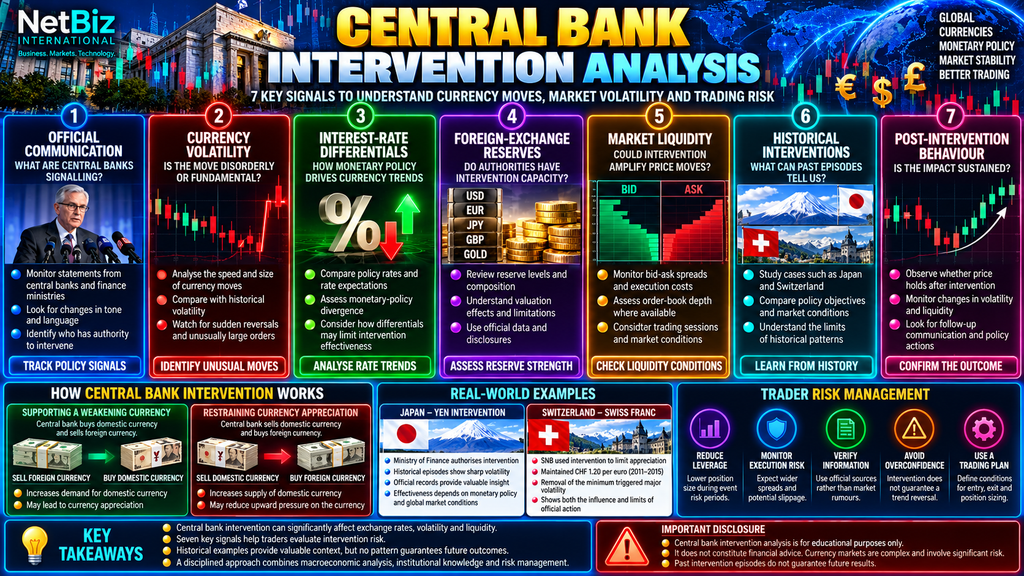
Seven Powerful Signals for Central Bank Intervention Analysis
1. Official Statements and Policy Communication
Official communication is often the first observable indication that authorities are becoming uncomfortable with currency-market conditions.
Finance ministers, central-bank governors and senior officials may describe exchange-rate movements as excessive, speculative, disorderly or inconsistent with economic fundamentals.
These statements deserve attention because they reveal official concerns and may influence traders’ expectations. However, words alone do not establish that intervention will follow.
Analysts should consider who made the statement, whether that institution has intervention authority, how the wording compares with earlier communication and whether multiple agencies are expressing a consistent position.
For example, in Japan, the Ministry of Finance has responsibility for foreign-exchange intervention decisions, while the Bank of Japan acts as an agent in executing operations. This distinction matters when interpreting official announcements.
Consult the Japanese Ministry of Finance intervention information for official records and related material.
2. Exchange-Rate Speed and Disorderly Volatility
The speed of currency movement can be as important as the exchange-rate level itself.
A gradual depreciation driven by a persistent interest-rate differential may attract a different policy response from an abrupt depreciation accompanied by poor liquidity and one-sided positioning.
Traders can monitor intraday percentage changes, realised volatility, trading ranges and the relationship between current price movements and historical volatility.
However, there is no universal percentage change that automatically triggers central-bank intervention. Each episode must be interpreted in its institutional and economic context.
Sudden reversals, unusually large candles and rapid price acceleration may be consistent with intervention, but they can also arise from economic news, leveraged position liquidation or large private orders.
3. Interest-Rate Differentials and Monetary-Policy Divergence
Interest-rate expectations are fundamental drivers of currency valuation. When policy expectations diverge between two economies, the resulting yield differential may encourage international capital flows and influence exchange rates.
This creates an important constraint on intervention. A central bank attempting to support a weakening currency may face persistent selling pressure if its monetary stance remains significantly more accommodative than that of its trading partners.
In such circumstances, intervention may temporarily disrupt market positioning without reversing the underlying incentive structure.
Traders should monitor policy rates, government bond yields, expected rate paths, inflation developments and central-bank guidance. The direction of intervention and the direction of monetary-policy fundamentals may reinforce or contradict one another.
4. Foreign-Exchange Reserves and Intervention Capacity
Foreign-exchange reserves provide authorities with assets that may be used in currency-market operations, depending on their legal framework and operational arrangements.
Reserves can include foreign-currency deposits, government securities and other qualifying reserve assets. Their composition and liquidity matter when assessing intervention capacity.
Nevertheless, a large reserve balance does not mean that authorities intend to intervene. Similarly, a monthly decline in published reserves does not by itself prove that a currency-support operation occurred.
Reserve valuations change as exchange rates, bond prices and other asset values fluctuate. Governments may also undertake transactions unrelated to exchange-rate management.
For a reliable assessment, compare official intervention disclosures, reserve data, valuation effects and policy statements rather than treating one reserve figure as decisive evidence.
5. Market Liquidity and Order-Book Conditions
Foreign-exchange markets are deep but not uniformly liquid. Liquidity varies by currency pair, trading session, market event and venue.
An unusually large official transaction may have a greater immediate effect when order-book depth is limited, market makers reduce quotations or bid-ask spreads widen.
Market participants can assess available liquidity through quoted spreads, execution quality, price impact, market depth where observable and trading conditions across sessions.
These concepts are closely related to market microstructure, which examines how orders, liquidity providers and execution mechanisms affect prices.
One important caution is that spot Forex is a decentralised over-the-counter market. No single retail platform displays the complete global order book. Liquidity indicators should therefore be interpreted as partial observations rather than comprehensive market measurements.
6. Historical Intervention Patterns and Institutional Credibility
Historical interventions provide evidence about how official actions have influenced markets under different conditions.
However, historical episodes must be compared carefully. An intervention conducted under a fixed exchange-rate regime is not directly comparable with an operation under a freely floating exchange-rate system.
Important variables include intervention size, whether the operation was announced, the credibility of the authority, the prevailing monetary-policy stance and whether multiple countries coordinated their actions.
Historical research also highlights the difference between an immediate price reaction and a sustained exchange-rate change. A sharp movement following intervention does not establish that the policy achieved its longer-term objective.
7. Post-Intervention Price Behaviour
After suspected or confirmed intervention, analysts should examine whether the initial currency movement is sustained.
Key questions include whether price holds beyond an important technical level, whether volatility begins to normalise, whether liquidity returns and whether subsequent official communication supports the original action.
A rapid reversal may indicate that the operation had only a temporary impact. Conversely, a more durable shift may emerge when intervention coincides with changing interest-rate expectations, broader macroeconomic developments or coordinated policy measures.
Even then, causation is difficult to establish. Currency markets respond simultaneously to many influences, and the precise contribution of intervention cannot always be isolated.
How Direct Foreign-Exchange Intervention Works
Supporting a Weakening Currency
Suppose a domestic currency is depreciating rapidly and authorities decide that market conditions warrant intervention.
They may sell foreign currency from available reserves and purchase domestic currency. This creates additional demand for the domestic currency in the foreign-exchange market.
The immediate effect may be a sharp appreciation, especially if speculative traders are positioned heavily against the currency. Yet the sustainability of the movement depends on whether private-market demand develops after the official operation.
Restraining Currency Appreciation
An authority concerned about excessive appreciation may take the opposite approach: selling domestic currency and purchasing foreign currency.
Such operations can increase official reserve assets and may reduce upward pressure on the domestic exchange rate.
However, persistent private capital inflows and strong economic fundamentals can make sustained resistance expensive or operationally difficult.
Sterilised and Unsterilised Intervention
Another important distinction concerns the domestic monetary consequences of intervention.
Sterilised intervention generally involves offsetting the impact of foreign-exchange transactions on domestic liquidity through separate monetary operations.
Unsterilised intervention allows the associated change in domestic monetary conditions to remain, potentially influencing interest rates and broader financial conditions.
The distinction matters because an exchange-rate operation that also changes domestic liquidity can affect the currency through more than one channel.
Historical Case Studies in Central Bank Intervention Analysis
Japan: Yen Intervention and Policy Divergence
Japan provides a particularly useful example because official intervention records are published and the institutional responsibilities are clearly defined.
When the yen weakens sharply, traders often examine the relationship between Japanese monetary policy, overseas interest rates, official statements and the pace of exchange-rate movement.
Historical yen-buying operations demonstrate that intervention can create substantial immediate volatility. They also show why traders must distinguish short-term exchange-rate disruption from changes in the broader monetary-policy environment.
The correct analytical approach is to consult official Ministry of Finance disclosures rather than assume that every abrupt USD/JPY decline was caused by intervention.
Switzerland: The Swiss Franc and Exchange-Rate Policy
Switzerland illustrates a different policy environment. The Swiss National Bank has historically used foreign-exchange purchases and other policy instruments to address currency conditions.
From September 2011 until January 2015, the SNB maintained a minimum exchange rate of CHF 1.20 per euro. Its decision to discontinue that minimum in January 2015 triggered extraordinary exchange-rate volatility.
This episode demonstrates a central lesson: an official exchange-rate commitment can significantly influence market expectations, but it should not be mistaken for a permanent guarantee.
For primary-source background, consult the Swiss National Bank and its historical monetary-policy announcements.
Coordinated Intervention and International Cooperation
At times, intervention has involved cooperation between multiple monetary authorities.
Coordinated actions may convey a stronger policy signal because several institutions are communicating a shared concern. Nevertheless, coordination does not eliminate uncertainty about the size, duration or effectiveness of the resulting market impact.
The 1985 Plaza Accord and subsequent coordinated actions are widely studied examples of international efforts to influence major currency relationships.
Analysts should distinguish the agreement’s policy objectives from the many economic forces that affected exchange rates during the surrounding period.
How Traders Can Identify Possible Intervention Risk
A practical monitoring framework should combine macroeconomic, institutional and market evidence.
First, establish the currency’s broader economic context. Examine inflation, interest-rate expectations, growth conditions and external balances.
Second, review official statements. Pay attention to changes in language and whether comments originate from the authority responsible for intervention decisions.
Third, assess price behaviour. Identify unusually rapid movements, disorderly trading conditions and sharp changes in volatility.
Fourth, evaluate liquidity and positioning. Thin markets and concentrated speculative positions can magnify reactions to both intervention and rumours.
Finally, verify any reported operation using official disclosures where possible. An unexpected price movement is not equivalent to confirmed government activity.
This framework complements established institutional order-flow analysis and helps traders understand why large market participants may alter execution conditions.
Practical Example: Analysing Suspected USD/JPY Intervention
Consider a hypothetical situation in which USD/JPY rises rapidly during a period of substantial interest-rate divergence.
Japanese officials begin expressing concern about excessive currency movements. Traders observe elevated volatility and increasingly one-sided positioning.
During a relatively thin trading period, USD/JPY suddenly falls sharply.
Several explanations are possible. The move could reflect official yen buying, a large private-market order, liquidation of leveraged positions or an unexpected news development.
A disciplined analyst would avoid declaring intervention solely from the price chart.
Instead, the analyst would review the timing of official comments, relevant news, liquidity conditions, subsequent price action and eventual government disclosures.
From a risk-management perspective, the key observation is that spreads and execution costs can change abruptly. Stop-loss orders may execute at worse prices than expected during extreme volatility.
The appropriate conclusion is not that a sharp fall must continue. It is that the probability of unusual market behaviour has increased and position sizing should reflect that uncertainty.
Advantages and Limitations of Central Bank Intervention Analysis
Advantages
Intervention analysis provides a structured way to incorporate official policy behaviour into Forex market assessment.
It can improve awareness of event risk, explain unusual volatility, identify important communication changes and help traders avoid treating exchange-rate movements as purely technical phenomena.
It also encourages the use of authoritative sources and a clearer distinction between confirmed information and market speculation.
Limitations
Intervention may not be disclosed immediately. Even where official records are eventually published, the delay can make real-time attribution difficult.
Currency markets are influenced by numerous simultaneous forces, making it difficult to measure intervention effectiveness precisely.
Authorities can change their strategies without warning, and historical intervention levels are not necessarily reliable future thresholds.
Finally, retail trading platforms provide incomplete visibility into global spot Forex liquidity, limiting the precision of order-flow inference.
Risk Management During Intervention Events
Intervention risk requires particular attention because exchange-rate movements may become discontinuous and execution conditions may deteriorate.
Traders should consider reducing leverage, reviewing open exposure, avoiding excessive concentration in correlated currency pairs and maintaining sufficient margin buffers.
Pending orders and stop-loss instructions should be assessed in light of potential slippage. A stop-loss is an important risk control, but it does not guarantee execution at the specified price in a fast market.
It is also prudent to avoid initiating positions merely because social media reports claim that intervention is imminent.
A well-defined trading plan should specify the conditions under which exposure will be reduced or trading suspended.
These precautions align with broader smart money concepts in Forex and the importance of understanding liquidity and execution risk.
Common Mistakes in Central Bank Intervention Analysis
Assuming Officials Always Defend a Specific Price
Market commentary frequently focuses on round-number exchange rates as potential intervention levels. Such levels may influence expectations, but there is no reason to assume that authorities have committed to defending an undisclosed price.
Confusing Verbal Intervention With Actual Transactions
Official warnings can move markets through expectations alone. They do not establish that authorities bought or sold currency.
Assuming Intervention Guarantees a Trend Reversal
An intervention may temporarily change market direction without overcoming persistent economic fundamentals.
Ignoring Liquidity and Execution Costs
Price charts do not fully capture spread widening, order rejection or slippage. These factors can determine the actual result of a trade.
Relying on Unverified Intervention Rumours
Social-media speculation may spread rapidly during volatile sessions. Traders should distinguish rumours, media reports, official statements and confirmed transaction data.
How Central Bank Intervention Analysis Fits Into a Trading Framework
Intervention analysis is most useful as part of a broader decision process rather than as an isolated trading signal.
A macroeconomic layer identifies the currency’s fundamental drivers. An institutional layer assesses policy objectives and communication. A market-structure layer evaluates volatility, liquidity and price behaviour.
A risk layer then determines whether trading conditions are acceptable.
For example, a trader may identify a technically attractive setup but decide not to enter because official intervention warnings create an unusually asymmetric event risk.
Alternatively, a trader may wait for market conditions to stabilise before assessing whether the original technical setup remains valid.
The same principles apply when evaluating liquidity sweeps and stop hunts, where sudden price movements should not be interpreted without understanding their wider context.
Conclusion: Central Bank Intervention Analysis
Central Bank Intervention Analysis provides an essential perspective on the relationship between official policy and foreign-exchange market behaviour.
The seven areas examined in this guide—official communication, volatility, interest-rate differentials, foreign-exchange reserves, market liquidity, historical intervention patterns and post-intervention behaviour—form a practical framework for understanding intervention risk.
However, no single indicator reliably predicts when authorities will act or whether an intervention will succeed.
The most effective analytical approach combines institutional knowledge, macroeconomic fundamentals, official information, market structure and disciplined risk management.
For Forex traders, the objective should not be to predict every central-bank transaction. It should be to recognise when intervention risk is rising, understand how market conditions may change and protect trading capital when uncertainty becomes unusually high.
No responses yet