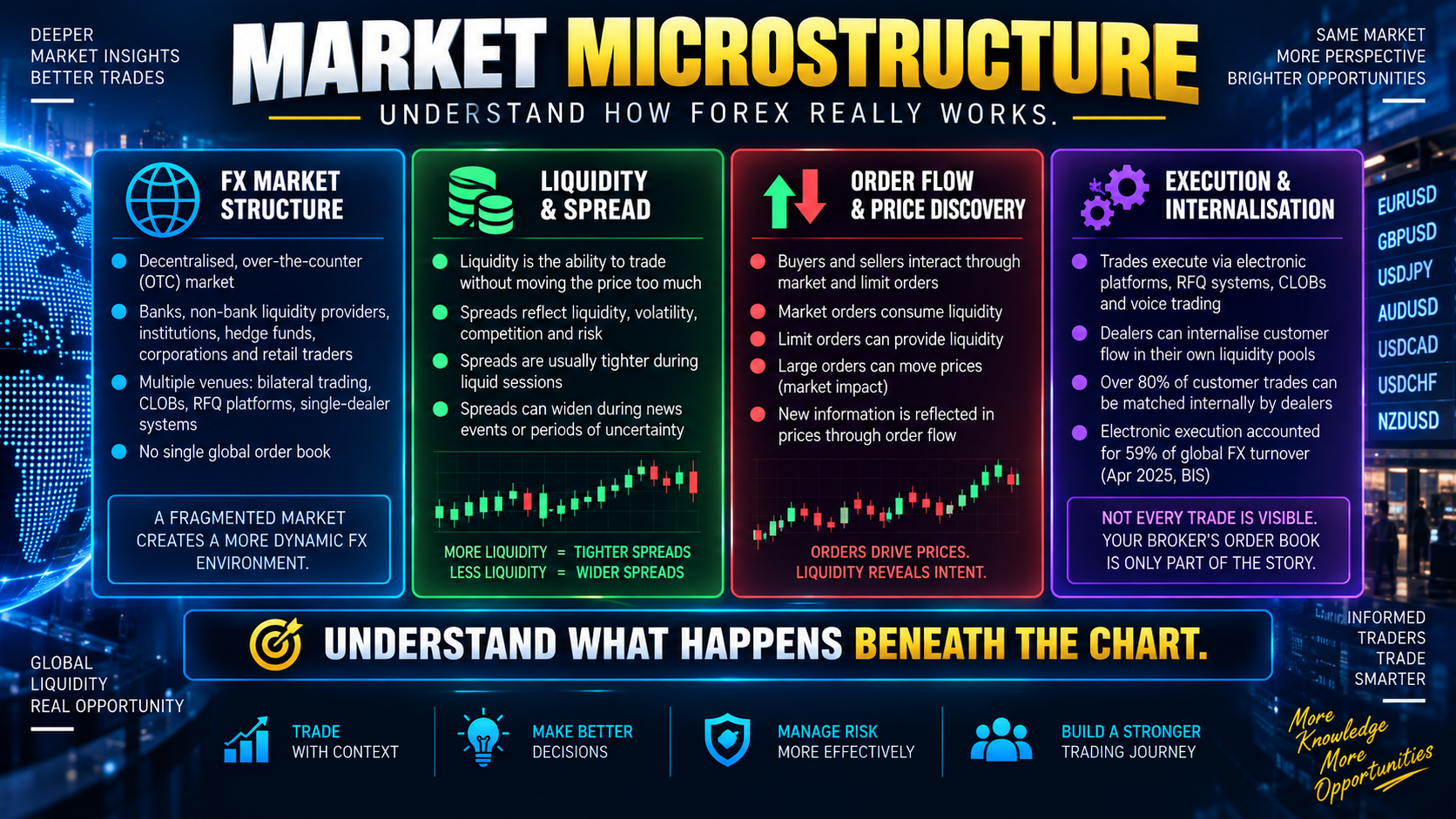
Market Microstructure examines what happens beneath the price chart: how buyers and sellers interact, how dealers quote currencies, how orders are executed, how liquidity is supplied and consumed, and how trading activity contributes to price discovery. For Forex traders, understanding these mechanisms provides a deeper explanation of why spreads change, why slippage occurs, why prices sometimes move rapidly and why execution can differ between apparently similar market conditions.
This subject is especially important in foreign exchange because spot FX is not organised around one central global exchange. It is predominantly an over-the-counter market involving banks, non-bank liquidity providers, institutional investors, hedge funds, corporations, brokers and other participants interacting across a fragmented network of trading relationships and venues.
A retail trading platform therefore shows only one window into a much larger ecosystem. There is no single universal spot-FX order book containing every bid, offer and transaction worldwide.
Understanding this structure helps connect several concepts traders already encounter—including spreads, liquidity, order flow, market impact, slippage, volatility, institutional execution and price discovery.
What Is Market Microstructure?
Market Microstructure is the study of the mechanisms and processes through which financial assets are traded.
Traditional financial analysis often asks why an asset should have a particular value. Microstructure asks a different set of questions:
- Who is buying and selling?
- How are orders submitted?
- Who provides liquidity?
- How are bid and ask prices determined?
- How are trades matched or negotiated?
- How does information become reflected in prices?
- What causes spreads and transaction costs?
- How does a large order affect the market?
In Forex, these questions are complicated by the decentralised structure of the market.
The Bank for International Settlements describes spot and most FX derivatives trading as over-the-counter, with dealers acting as intermediaries across a decentralised and fragmented trading environment.
This means understanding Forex requires more than examining candlestick patterns. The mechanisms behind those candles also matter.
Why Market Microstructure Matters in Forex
Every candlestick is the visible result of transactions and changing quotations occurring within the market.
When EUR/USD moves from one price to another, that movement is not generated by the chart itself. It emerges from the interaction of orders, liquidity providers, dealers, customers, algorithms and changing information.
Market microstructure helps explain several practical observations familiar to traders:
- spreads can widen during economic announcements;
- market orders may experience slippage;
- large transactions can move prices;
- liquidity varies throughout the trading day;
- different brokers can display slightly different prices;
- some price levels attract greater trading activity than others; and
- execution quality can change even when the trading strategy remains identical.
Microstructure therefore forms a bridge between theoretical trading analysis and actual trade execution.
The Decentralised Structure of the Forex Market
One of the most important characteristics of Forex is that the global spot market does not operate through a single centralised exchange.
In an exchange-traded market, participants can interact through a central venue with defined rules and an order book associated with that venue.
Spot FX is different.
Trading occurs through a network of bilateral dealer relationships and electronic venues. Participants may trade directly with dealers, through multi-dealer platforms, through electronic brokers, through central limit order books or through request-for-quote systems.
The result is a fragmented market.
Different participants can see different liquidity and receive different prices depending on their counterparty relationships, trading size, credit arrangements, technology and execution venue.
This is why a retail trader should be cautious about interpreting any individual broker’s depth-of-market display as a complete representation of global Forex liquidity.
Who Participates in Forex Market Microstructure?
The FX market contains participants with very different objectives.
Dealer Banks
Large banks have historically played a major role in making markets and intermediating customer transactions. Dealers quote bid and ask prices, manage inventory and facilitate transactions for institutional and corporate clients.
Non-Bank Liquidity Providers
Technology and electronic trading have enabled specialised non-bank firms to become important liquidity providers.
Some use sophisticated algorithms and high-speed infrastructure to quote prices across multiple venues.
Institutional Investors
Asset managers, pension funds and other institutional investors trade currencies for investment, hedging and portfolio-management purposes.
Hedge Funds and Proprietary Trading Firms
These participants may trade based on macroeconomic views, quantitative models, arbitrage opportunities, relative value or short-term market behaviour.
Corporations
Businesses require foreign exchange for international trade, overseas investment, hedging and operational cash flows.
Retail Brokers and Traders
Retail traders typically access the FX market through brokers rather than participating directly in institutional inter-dealer markets.
These different objectives create the diverse order flow underlying currency prices.
Bid, Ask and the Spread
Market microstructure begins with two fundamental prices: the bid and the ask.
The bid represents the price at which a liquidity provider is prepared to buy a currency pair.
The ask, or offer, represents the price at which the liquidity provider is prepared to sell.
The difference is the bid-ask spread.
For example:
EUR/USD Bid: 1.10500
EUR/USD Ask: 1.10508
The spread is 0.00008, or 0.8 pip.
The spread is not necessarily constant. It can respond to competition between liquidity providers, volatility, available liquidity, information risk and market conditions.
During active trading periods in major currency pairs, competition and liquidity can produce relatively narrow spreads.
During major news releases or periods of uncertainty, liquidity providers may widen quotes to compensate for greater risk.
Liquidity in Market Microstructure
Liquidity describes the ability to execute transactions without causing excessive changes in price.
A highly liquid market generally allows relatively large quantities to trade with lower transaction costs and limited market impact.
Liquidity has several dimensions.
Depth
Depth refers to how much trading interest is available at or near current prices.
Tightness
Tightness relates to transaction costs, particularly the distance between bid and ask quotations.
Resiliency
Resiliency describes how quickly liquidity and prices recover after a temporary imbalance or large transaction.
These characteristics can change rapidly. A market that appears highly liquid under normal conditions may become much thinner during an unexpected event.
Market Orders and Limit Orders
Orders interact with liquidity differently.
Market Orders Consume Liquidity
A market order seeks immediate execution against available quotations.
A trader buying at market accepts available offers. A trader selling at market accepts available bids.
If the order is larger than the quantity available at the best price, execution may continue at progressively less favourable prices.
This contributes to market impact and slippage.
Limit Orders Can Provide Liquidity
A limit order specifies a price constraint. Depending on how and where it is placed, a resting limit order can add liquidity by making additional trading interest available to incoming orders.
This interaction between liquidity-taking and liquidity-providing orders is fundamental to electronic market microstructure.
Order Flow and Price Discovery
Order flow refers broadly to the sequence and direction of trading activity reaching the market.
Buyers and sellers do not necessarily possess identical information, objectives or urgency.
A dealer observing persistent buying may infer that market conditions or information are changing. Quotations can adjust accordingly.
This process contributes to price discovery—the mechanism through which new information becomes incorporated into market prices.
Our previous discussion of institutional trading provides useful complementary context. The Smart Money Concepts in Forex article examines several popular ways traders interpret institutional activity and liquidity.
Market microstructure provides a more formal framework for understanding the mechanisms behind execution and price formation.
Dealer Inventory and Market Microstructure
Dealers that facilitate customer transactions can temporarily acquire currency exposure.
Suppose customers repeatedly buy EUR/USD from a dealer.
The dealer may accumulate an inventory position that it does not wish to retain indefinitely.
It can respond in several ways:
- adjust its bid and ask quotations;
- encourage offsetting customer flow;
- hedge externally;
- trade with another dealer or liquidity provider; or
- manage the exposure within a broader portfolio.
Inventory management is therefore one mechanism linking customer trading activity to dealer pricing behaviour.
What Is Internalisation?
Internalisation occurs when a dealer matches customer transactions internally rather than immediately hedging every trade in the external market.
For example, one customer may buy EUR/USD while another sells approximately the same quantity. A dealer may be able to offset these flows internally.
Recent BIS analysis shows how significant this mechanism has become. Dealers can match a substantial majority of customer transactions within their own internal liquidity pools.
This has an important implication for retail interpretations of institutional activity: not every customer transaction produces an immediately visible transaction in an external inter-dealer venue.
A large part of FX activity can therefore remain non-visible to other market participants.
Visible and Non-Visible Liquidity
Traders sometimes imagine Forex liquidity as though every order were displayed in one global queue.
That is not how the market operates.
Some trading interest is visible on particular electronic venues. Other liquidity exists within dealer systems, bilateral relationships, request-for-quote arrangements or internal liquidity pools.
Consequently, no ordinary retail chart reveals the complete global order distribution.
This is particularly relevant when analysing Liquidity Sweeps and Stop Hunts.
A chart can show that price moved through a previous high or low and then reversed. It cannot, by itself, reveal every order triggered globally or prove which participant caused the movement.
Market microstructure provides the reason for that limitation: liquidity is fragmented and much of it is not publicly visible.
Electronic Trading and Market Microstructure
Technology has transformed the Forex market.
Trading that once depended heavily on voice communication increasingly occurs through electronic systems.
Modern execution environments include:
- electronic communication networks;
- central limit order books;
- request-for-quote platforms;
- multi-dealer platforms;
- single-dealer platforms;
- algorithmic execution systems; and
- voice trading for certain transactions.
BIS research shows that electronic execution accounted for a majority of global FX turnover in its April 2025 execution-method data, although voice execution remains significant.
Electronic trading has increased automation, speed and connectivity, but it has not converted global spot FX into one centralised market.
Central Limit Order Books and RFQ Trading
Two execution structures illustrate the diversity of modern FX trading.
Central Limit Order Books
A central limit order book, or CLOB, organises buy and sell interest according to price and other matching rules on a particular venue.
Participants can interact with displayed liquidity, subject to that venue’s access arrangements.
Request for Quote
In an RFQ process, a participant requests prices from one or more liquidity providers.
The providers respond with quotations, and the customer chooses whether to execute.
RFQ trading can be particularly useful when transaction characteristics or size require more tailored liquidity.
These structures demonstrate why the phrase “the Forex order book” can be misleading. There are multiple liquidity pools and execution mechanisms rather than one universal book.
Algorithmic Trading and Execution
Algorithms are now deeply integrated into market microstructure.
Liquidity providers can use algorithms to update quotations, manage inventory, identify risk and hedge positions.
Institutional traders can also use execution algorithms to divide large transactions into smaller components.
Instead of attempting to execute a very large currency order immediately, an algorithm may distribute the transaction across time or venues.
The objective may be to reduce market impact, obtain better average execution or limit information leakage.
This is one reason institutional execution can look very different from a retail trader clicking “buy” or “sell.”
Market Impact and Large Orders
Market impact describes the effect a transaction has on prices.
Suppose a participant wants to buy an unusually large quantity of EUR/USD immediately.
If insufficient quantity is available at the best offer, the order may consume liquidity across multiple price levels.
The average execution price becomes worse as the transaction progresses.
This creates a practical problem for institutions: the act of executing the trade can increase its own cost.
Large traders therefore frequently care not only about predicting market direction but also about how an order should be executed.
Slippage Explained Through Market Microstructure
Slippage occurs when an order executes at a different price from the price a trader expected.
It is often treated as purely a broker issue, but legitimate slippage can arise naturally from market mechanics.
Prices can change between order submission and execution. Available quantity at the quoted price can disappear. Fast-moving markets can move through several price levels before an order is filled.
Slippage tends to become more important during:
- major economic announcements;
- unexpected geopolitical events;
- thin trading periods;
- market openings;
- rapid volatility expansions; and
- large order execution.
Slippage can be negative or positive, depending on the execution mechanism and market movement.
Why Spreads Widen During News Events
Economic releases can rapidly change expectations about interest rates, inflation, growth and monetary policy.
Immediately before or after important information arrives, liquidity providers face greater uncertainty.
They may not know where the equilibrium market price will settle, and quotations can become stale very quickly.
Providers may respond by reducing quoted size, widening spreads or rapidly updating prices.
The result for traders can be:
- wider spreads;
- greater slippage;
- rapid price movement;
- reduced depth; and
- less predictable execution.
This behaviour can be understood through microstructure rather than assuming every unusual price movement represents manipulation.
Market Microstructure and Liquidity Sweeps
Market Microstructure also provides useful context for understanding why price sometimes moves beyond obvious technical levels.
Previous highs, lows and range boundaries can become areas where many traders make similar decisions.
Breakout orders may activate beyond a level. Stop-loss orders may become market orders. Other participants may provide or withdraw liquidity around the same area.
The resulting imbalance can create rapid movement.
Whether price subsequently reverses or continues depends on the liquidity available, incoming order flow and broader market conditions.
Microstructure therefore helps move the discussion beyond the simplistic claim that every sweep is an intentional “stop hunt.”
Market Microstructure and Support and Resistance
Technical traders frequently identify support and resistance using previous turning points and trading ranges.
Microstructure adds another interpretation.
A level can matter because it influences the behaviour of many participants. Traders may submit entries, exits, stops and limit orders around visible reference points.
If enough activity concentrates around a level, interaction between aggressive orders and available liquidity can produce a significant price response.
But support and resistance are not physical barriers.
If aggressive order flow overwhelms available liquidity, price can move through the level.
This is why confirmation and risk management remain important when using technical levels.
A Practical Market Microstructure Example
Consider EUR/USD trading around 1.1000 before a major economic release.
Under normal conditions, liquidity is deep and the spread is narrow.
As the announcement approaches, some liquidity providers reduce their quoted size because of uncertainty.
The release is substantially different from market expectations.
Buy orders arrive rapidly.
The available offers closest to the previous market price are consumed. Algorithms update quotations. Some dealers hedge externally. Stop orders above nearby highs activate and become additional buying demand.
EUR/USD moves rapidly higher.
A retail chart records the result as a large bullish candle.
Market microstructure describes what may be happening beneath that candle:
- liquidity was reduced before the announcement;
- new information changed valuations;
- aggressive orders consumed available offers;
- quoted prices adjusted;
- additional conditional orders were triggered;
- dealers and algorithms managed resulting exposure; and
- price discovery continued until buying and selling became more balanced.
The chart shows the outcome. Microstructure explains the trading process that can produce it.
Advantages and Limitations of Market Microstructure
Market microstructure offers several advantages for traders.
- It provides a realistic understanding of how Forex operates.
- It explains spreads, slippage and market impact.
- It clarifies the role of dealers and liquidity providers.
- It improves understanding of order flow and price discovery.
- It provides context for liquidity sweeps and breakouts.
- It helps explain why execution quality changes over time.
However, there are important limitations.
- Retail traders cannot observe the entire global FX market.
- Liquidity is fragmented across multiple venues.
- Dealer internalisation makes some activity non-visible.
- Broker order-book data represents only a subset of market activity.
- Institutional execution data can be proprietary.
- Microstructure does not provide a guaranteed directional forecast.
The framework improves understanding, but it does not eliminate uncertainty.
Risk Management and Practical Considerations
Understanding microstructure should influence how traders think about execution risk.
A stop-loss defines an intended exit mechanism, but extreme volatility can produce execution away from the requested trigger price.
A market order prioritises execution rather than a specific price.
A limit order prioritises price but may not execute.
These are execution trade-offs rather than contradictions.
Traders should consider:
- spread conditions before entering;
- liquidity at the chosen trading time;
- scheduled economic announcements;
- potential slippage;
- position size;
- order type; and
- the reliability and execution model of the broker.
NetBiz’s Forex Trading Strategy and EUR/USD guide provides broader context for integrating execution considerations into a structured trading plan.
Common Mistakes When Studying Market Microstructure
Assuming There Is One Global Forex Order Book
Spot FX is decentralised and fragmented. One broker or venue cannot show every global order.
Treating Every Price Movement as Manipulation
Rapid moves can arise from ordinary liquidity imbalances, information arrival, reduced depth and order execution.
Ignoring Execution Costs
A strategy can appear profitable before spreads, commissions and slippage but perform very differently after realistic transaction costs.
Confusing Market Orders With Limit Orders
They serve different execution priorities. Market orders prioritise immediacy; limit orders constrain execution price.
Assuming More Data Means Complete Information
Depth-of-market tools can be useful, but the data remains specific to particular liquidity pools or venues.
Using Microstructure as a Directional Signal
Microstructure explains trading mechanisms. It does not automatically predict whether EUR/USD will rise or fall next.
How Market Microstructure Fits Into a Trading Framework
Market Microstructure works best as an additional layer within a broader trading framework.
A trader might first identify the higher-timeframe trend, support and resistance, volatility environment and scheduled economic events.
Microstructure considerations can then refine execution:
- Identify the market environment. Determine whether conditions are liquid, volatile, trending or range-bound.
- Consider the trading session. Liquidity differs between Asian, European and North American trading hours.
- Review scheduled events. Major releases can materially alter spreads and execution.
- Choose the appropriate order type. Understand the trade-off between execution certainty and price certainty.
- Observe spreads. A sudden expansion can indicate changing liquidity conditions.
- Account for slippage. Backtests and trading plans should include realistic execution assumptions.
- Control position size. Execution uncertainty should not undermine overall risk limits.
- Evaluate the outcome. Separate strategy errors from execution effects when reviewing trades.
For breakout traders, the NetBiz Breakout Trading Strategy for GBPUSD and Gold can be complemented by microstructure analysis to understand what may occur as price approaches and passes an important level.
The Most Important Lesson From Market Microstructure
The central lesson is simple: the chart is the visible output of a trading process.
Prices emerge from interaction between participants with different objectives, information, time horizons and execution requirements.
Liquidity is not constant. Spreads are not constant. Market depth is not constant. Execution quality is not constant.
And because Forex is fragmented, no retail trader sees the entire market.
Understanding these realities can produce a more disciplined interpretation of price action.
Instead of asking only, “What pattern is on the chart?”, traders can also ask:
What market mechanics could be producing this behaviour?
Conclusion: Understanding Market Microstructure
Market Microstructure provides the framework for understanding how Forex trading actually functions beneath the candlestick chart.
It explains how dealers, liquidity providers, institutional investors, corporations, algorithms and other participants interact through a decentralised network of trading venues and bilateral relationships.
It also explains practical trading phenomena including bid-ask spreads, liquidity, order flow, dealer inventory, internalisation, market impact, slippage and price discovery.
The modern FX market is highly electronic, but it remains fragmented. Central limit order books, request-for-quote systems, multi-dealer venues, single-dealer platforms and voice execution can all form part of the wider trading ecosystem.
This structure places an important limitation on retail analysis: a broker’s data cannot reveal every order or liquidity pool in the global market.
That limitation is particularly important when interpreting institutional order flow, liquidity sweeps and alleged stop hunts. Price behaviour can provide evidence about what occurred on the chart, but it does not automatically reveal the identity or intent of every participant behind the movement.
Market microstructure should therefore not be treated as a secret method for predicting every short-term price movement. Its real value is more fundamental: it helps traders understand how liquidity, execution, information and order flow interact to create the prices they see.
Combined with technical analysis, market context and disciplined risk management, that understanding can lead to more realistic trading assumptions and better-informed execution decisions.
No responses yet