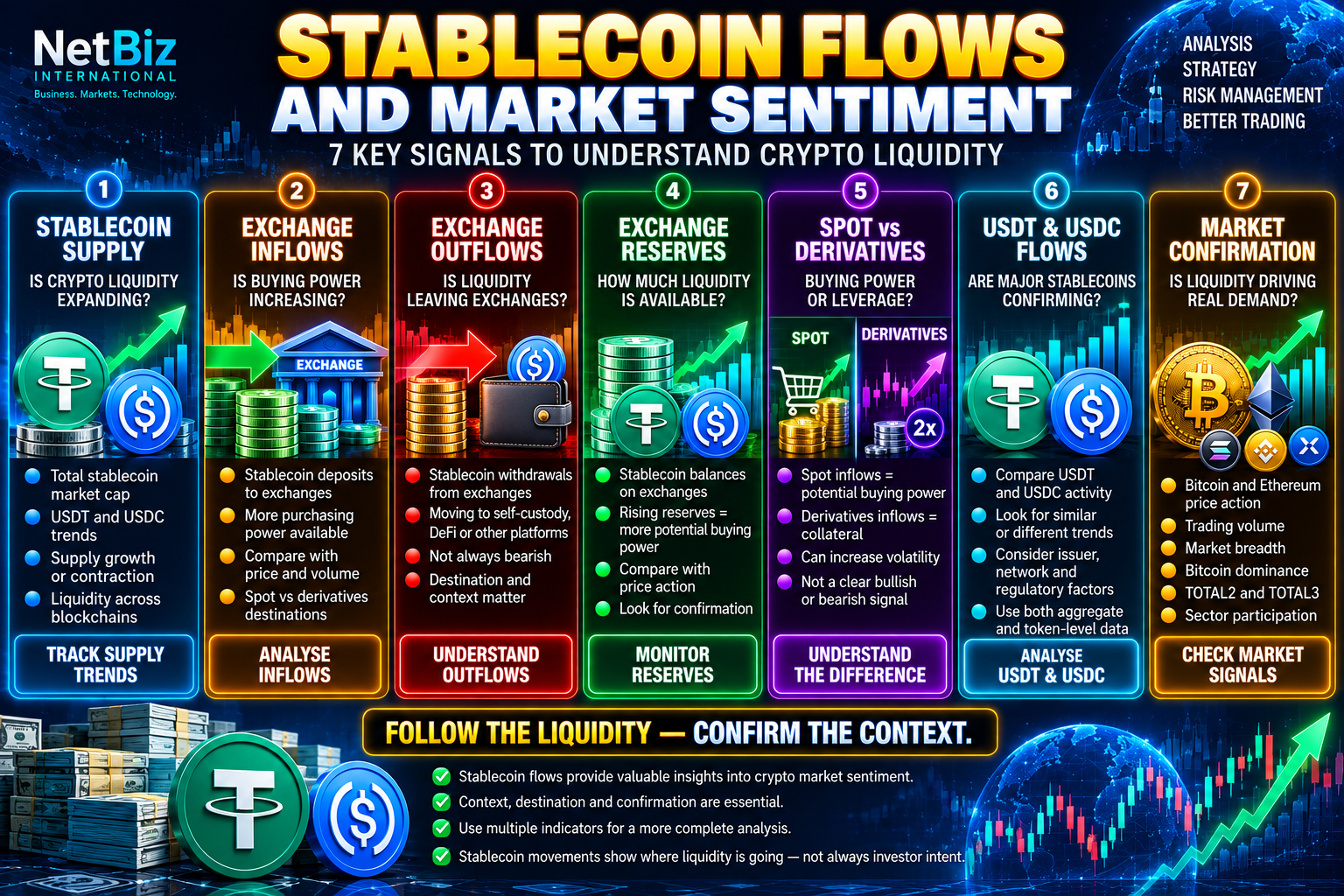
Stablecoin Flows and Market Sentiment can provide valuable insight into the movement of liquidity throughout cryptocurrency markets. Stablecoins such as Tether (USDT) and USD Coin (USDC) are widely used as trading assets, settlement instruments, collateral and stores of dollar-linked value within the digital-asset ecosystem. Because they sit between traditional currencies and volatile cryptocurrencies, changes in stablecoin supply and movement can reveal important shifts in market conditions.
However, stablecoin analysis requires context. A large stablecoin transfer does not automatically mean that somebody is preparing to buy Bitcoin. An exchange inflow is not always bullish, and an exchange outflow is not always bearish. Stablecoins are used for spot trading, derivatives collateral, decentralised finance, payments, cross-border transfers and many other purposes.
The objective of stablecoin-flow analysis is therefore not to predict markets from a single transaction. It is to understand how dollar-linked liquidity is entering, leaving and moving through the crypto ecosystem—and then compare those movements with other market evidence.
What Are Stablecoin Flows and Market Sentiment?
Stablecoin flows describe movements of stablecoins between wallets, cryptocurrency exchanges, decentralised finance protocols, blockchain networks and other parts of the digital-asset ecosystem.
Market sentiment describes the general attitude of market participants toward risk. Sentiment can range from strong optimism and aggressive risk-taking to uncertainty, defensive positioning and outright fear.
The relationship between Stablecoin Flows and Market Sentiment exists because stablecoins provide one of the principal liquidity mechanisms used within cryptocurrency markets.
A trader who sells Bitcoin into USDT, for example, may remain inside the crypto ecosystem while reducing exposure to Bitcoin volatility. The trader could later redeploy that USDT into Bitcoin, Ethereum or another cryptocurrency without first returning to a traditional bank account.

This makes stablecoins an important bridge between risk exposure and relatively stable dollar-linked liquidity.
The Bank for International Settlements describes stablecoins as having become a dominant medium of exchange within the crypto ecosystem. Their role has also expanded into payments, cross-border transactions and connections with traditional financial markets.
Why Stablecoin Flows and Market Sentiment Matter
Crypto markets require liquidity. Buyers need capital with which to purchase assets, while sellers need counterparties willing to provide that capital.
Stablecoins make this process considerably easier because traders can move between volatile crypto assets and dollar-linked tokens without necessarily leaving blockchain-based markets.
This means analysts can examine several questions:
- Is the total stablecoin supply expanding?
- Are stablecoins moving onto or away from exchanges?
- Are exchange stablecoin reserves increasing?
- Is liquidity concentrated in particular blockchain ecosystems?
- Are USDT and USDC flows confirming one another?
- Is stablecoin liquidity accompanying stronger trading volume?
- Is capital rotating from stablecoins into Bitcoin or altcoins?
None of these questions provides a complete answer independently. Together, however, they can provide a richer picture of liquidity conditions.
Stablecoins as Crypto Market Liquidity
One useful way to think about stablecoins is as a form of liquid capital within digital-asset markets.
A trader holding USDT rather than Bitcoin has reduced direct exposure to Bitcoin’s price movements while retaining an asset that can often be deployed rapidly across exchanges and blockchain applications.
This creates what is sometimes described as potential purchasing power.
But the word potential is important.
Stablecoin liquidity sitting on an exchange does not have to buy cryptocurrency. It can remain idle, be withdrawn, serve as collateral or be transferred elsewhere.
Therefore:
Available liquidity is not the same thing as confirmed buying demand.
This distinction should remain central to any interpretation of Stablecoin Flows and Market Sentiment.
Indicator 1: Total Stablecoin Supply
The first metric to monitor is the total supply or market capitalisation of stablecoins.
When issuers create additional fiat-backed stablecoins in response to legitimate demand, the amount of dollar-linked liquidity represented on-chain increases. Persistent growth across the broader stablecoin sector can therefore indicate expanding use of blockchain-based dollar liquidity.
Conversely, sustained redemptions can reduce stablecoin supply.
However, supply growth should not automatically be labelled bullish.
New stablecoins may be used for trading, payments, savings, cross-border transfers, decentralised finance or other purposes. The location and subsequent movement of that liquidity matter.
DefiLlama’s stablecoin dashboard is one resource for monitoring aggregate stablecoin market capitalisation, individual stablecoins and distribution across blockchain networks.
Supply Expansion Versus Capital Deployment
There is an important difference between stablecoin creation and stablecoin deployment.
Supply expansion tells us that more stablecoin value exists. It does not tell us whether that value has already entered Bitcoin, Ethereum or altcoins.
For that reason, stablecoin supply works better as a liquidity-context indicator than as an isolated trading signal.
Indicator 2: Stablecoin Exchange Inflows
Stablecoin exchange inflows measure stablecoins being transferred into wallets associated with cryptocurrency exchanges.
For spot exchanges, increasing stablecoin deposits can indicate that more purchasing power is becoming available within the trading venue.
This differs from the traditional interpretation of Bitcoin exchange inflows.
When Bitcoin moves onto an exchange, analysts sometimes interpret the movement as increased potential sell-side supply. When stablecoins move onto a spot exchange, they may instead represent capital capable of purchasing crypto assets.
But again, capability is not intent.
A trader depositing USDT may buy Bitcoin immediately, wait several days, purchase an altcoin, transfer funds elsewhere or do nothing.
Stablecoin exchange inflows should therefore be compared with:
- Bitcoin and Ethereum price action;
- spot trading volume;
- market breadth;
- exchange reserves;
- Bitcoin dominance; and
- derivatives positioning.
Indicator 3: Stablecoin Exchange Outflows
Stablecoin exchange outflows occur when stablecoins leave exchange-associated wallets.
It is tempting to interpret these flows simply as declining purchasing power, but several explanations are possible.
Users may withdraw stablecoins into self-custody, move them into DeFi protocols, bridge them to another blockchain, send them to another exchange or use them for payments.
Large outflows therefore require investigation rather than immediate directional interpretation.
The destination matters.
Indicator 4: Stablecoin Exchange Reserves
Exchange reserves provide a broader view than individual inflows or outflows because they estimate the amount of an asset held in exchange-associated wallets.
Rising stablecoin reserves on spot exchanges can indicate increasing available purchasing power.
If stablecoin reserves rise while Bitcoin or Ethereum begins breaking above important resistance with expanding spot volume, the combination may provide stronger evidence of improving demand conditions than either signal alone.
Conversely, large reserves combined with weak price action can indicate that liquidity is available but market participants remain hesitant to deploy it.
This illustrates a recurring principle:
Liquidity creates capacity for market activity; price and volume help reveal whether that capacity is actually being used.
Indicator 5: Spot Exchanges Versus Derivatives Exchanges
One of the most important distinctions in Stablecoin Flows and Market Sentiment is the destination exchange type.
Stablecoins moving to a spot exchange can provide capital that may be used to purchase cryptocurrency directly.
Stablecoins moving to a derivatives exchange can have a different meaning.
They may be deposited as collateral for leveraged futures or perpetual positions.
That can increase speculative positioning and potential volatility without revealing whether traders are collectively bullish or bearish.
Therefore, a large derivatives-related stablecoin inflow should not automatically be described as buying pressure.
It may instead indicate that traders are preparing to take leveraged positions in either direction.
Indicator 6: USDT and USDC Flows
USDT and USDC dominate much of the stablecoin market, but their users, blockchain distribution and market applications are not identical.
Analysts can therefore examine whether liquidity trends are broad across major stablecoins or concentrated in one.
If aggregate stablecoin supply, USDT balances and USDC balances are all expanding alongside stronger crypto trading activity, the liquidity signal may be broader than a movement driven by only one token.
Differences between individual stablecoins can also arise from issuer-specific developments, regulation, institutional usage, blockchain migration or changes in market preference.
For this reason, aggregate data and token-specific data should both be considered.
Indicator 7: Stablecoin Liquidity Across Blockchains
Stablecoin analysis is not limited to centralised exchanges.
Stablecoins circulate across Ethereum, Tron, Solana, BNB Chain, Base, Arbitrum and numerous other networks.
Changes in stablecoin balances on individual chains can help identify where blockchain liquidity is accumulating.
For example, increasing stablecoin liquidity on a network combined with rising decentralised-exchange volume and growing activity across multiple protocols may indicate increasing economic activity within that ecosystem.
However, blockchain inflows alone do not prove speculative demand for the chain’s native token.
Stablecoins may arrive for payments, yield strategies, arbitrage, lending or transfers.
Stablecoin Flows and Bitcoin Dominance
Stablecoin analysis becomes more useful when combined with Bitcoin Dominance.
Suppose stablecoin liquidity is increasing while Bitcoin dominance is also rising strongly.
This may indicate that new crypto liquidity is favouring Bitcoin rather than spreading broadly across altcoins.
If stablecoin liquidity expands while Bitcoin dominance begins falling and market breadth improves, the environment may instead be consistent with wider capital rotation.
The interaction between liquidity and market leadership is often more informative than either metric in isolation.
Stablecoin Flows and Altcoin Season Indicators
This also connects directly with Altcoin Season Indicators.
A genuine broad altcoin rotation generally requires more than isolated price rallies.
Increasing stablecoin liquidity can provide favourable conditions, but analysts should also look for improving market breadth, stronger TOTAL2 or TOTAL3 structures, ETH/BTC relative strength, increased volume and participation across multiple sectors.
If stablecoin liquidity is increasing but only a few speculative tokens are rising, the evidence for broad market rotation remains weak.
Stablecoin Flows Through Crypto Market Cycles
The meaning of stablecoin movements can change during different phases of Crypto Market Cycles.
Risk-On Expansion
During an improving market, expanding stablecoin liquidity combined with stronger prices, rising spot volume and broad participation may support the interpretation that capital is entering or circulating more actively through crypto markets.
Profit-Taking
After a major rally, traders may sell volatile assets into stablecoins without leaving the crypto ecosystem. Stablecoin balances can therefore rise during profit-taking.
This is one reason why increasing stablecoin balances cannot automatically be considered bullish.
Risk-Off Conditions
During periods of stress, investors may rotate from volatile cryptocurrencies into stablecoins as a defensive action.
Some stablecoins themselves can also experience confidence problems, redemption pressure or deviations from their intended peg.
Stablecoin composition therefore matters as well as aggregate supply.
Stablecoin Flows and Exchange Reserves
Exchange-reserve analysis provides another useful comparison.
NetBiz has previously examined Bitcoin Exchange Reserves. Bitcoin reserves and stablecoin reserves can provide different information.
Bitcoin reserves relate partly to the amount of BTC potentially available within exchange infrastructure, while stablecoin reserves can reflect available dollar-linked liquidity.
Looking at both sides can create a more complete liquidity picture.
For example, declining Bitcoin reserves alongside growing spot stablecoin reserves and strengthening demand could describe a very different environment from rising Bitcoin deposits combined with falling stablecoin liquidity.
These relationships remain contextual rather than deterministic.
A Practical Stablecoin Flow Example
Consider a hypothetical market in which total stablecoin supply has been increasing for several weeks.
At the same time:
- stablecoin balances on spot exchanges are increasing;
- Bitcoin has broken above an established resistance level;
- spot trading volume is expanding;
- Ethereum is strengthening relative to Bitcoin;
- Bitcoin dominance has begun to decline; and
- a growing percentage of major altcoins are outperforming Bitcoin.
No single observation proves what happens next.
Collectively, however, the evidence would suggest that liquidity conditions and market participation are becoming more supportive of broader risk-taking.
Now consider a different situation.
Stablecoin deposits surge onto derivatives exchanges, leverage increases, Bitcoin remains below resistance and market breadth deteriorates.
Calling that stablecoin inflow “bullish” would ignore the context. The increase could instead be associated with leveraged speculation and higher volatility risk.
Stablecoin Minting Does Not Automatically Mean Buying
One common analytical mistake is assuming that every newly issued stablecoin represents fresh money immediately entering Bitcoin or another cryptocurrency.
Stablecoin issuance can occur for numerous reasons connected with market demand, inventory management and blockchain distribution.
Even when new supply represents additional capital entering the stablecoin ecosystem, the capital may remain in stablecoins rather than being deployed into volatile assets.
Analysts should therefore examine what happens after supply changes.
Does the liquidity reach exchanges?
Does spot volume increase?
Does market breadth strengthen?
Does price confirm demand?
Those subsequent observations provide important context.
Stablecoins as a Risk-Off Asset Within Crypto
Stablecoins occupy an unusual position in cryptocurrency markets.
They can represent potential risk capital, but they can also represent defensive positioning.
A trader moving from Bitcoin into USDT may be reducing risk. The same USDT could later become purchasing power if market conditions improve.
Stablecoin balances therefore sometimes represent capital sitting between two decisions.
This dual role explains why simple bullish-versus-bearish interpretations are often inadequate.
Market Capitalisation Is Not the Same as Cash Flow
Another important distinction concerns terminology.
Changes in cryptocurrency market capitalisation should not automatically be described as equivalent amounts of money entering or leaving the market.
Market capitalisation is generally calculated from token price multiplied by circulating supply.
Stablecoin issuance and redemption can provide more direct information about changes in stablecoin supply, but even this does not tell us exactly how the resulting tokens will be used.
Precise language helps prevent exaggerated conclusions.
Advantages of Stablecoin Flow Analysis
Stablecoin-flow analysis offers several useful advantages.
- It provides visibility into an important source of crypto liquidity.
- Much of the activity is observable on public blockchains.
- It can help distinguish capital sitting in stable assets from capital deployed into volatile assets.
- It can complement exchange-reserve analysis.
- It can support analysis of Bitcoin and altcoin market rotation.
- It can identify changing liquidity across blockchain ecosystems.
These characteristics make stablecoin data valuable within a broader market-analysis framework.
Limitations of Stablecoin Flows and Market Sentiment
The limitations are equally important.
Transfers Do Not Reveal Intent
Blockchain data shows that a transfer occurred. It usually does not tell us precisely why it occurred.
Exchange Labels Are Imperfect
On-chain analytics providers maintain address labels and clustering systems, but exchange wallet structures change. Different providers can therefore report different figures.
Internal Transfers Can Distort Activity
Large transfers may represent exchange wallet management rather than new investor behaviour.
Stablecoins Have Multiple Uses
Payments, remittances, DeFi, collateral, arbitrage and savings can all generate stablecoin transactions unrelated to directional crypto speculation.
Derivatives Complicate Interpretation
Stablecoin collateral can support long or short positions. Higher derivatives balances may therefore indicate increased leverage rather than a clear directional signal.
Issuer Risk Matters
Stablecoins are not risk-free. Reserve composition, redemption mechanisms, operational arrangements and market confidence can affect stability.
The US Federal Reserve has documented how stablecoin structures and primary and secondary markets can behave differently during periods of stress. Its analysis reinforces why stablecoins should not simply be treated as identical digital dollars.
Common Mistakes When Analysing Stablecoin Flows
Several mistakes repeatedly appear in simplified crypto-market commentary.
- Every stablecoin inflow is bullish. Destination and purpose matter.
- Every outflow is bearish. Funds may simply be moving to self-custody, DeFi or another network.
- Every mint means Bitcoin buying. Issuance does not establish subsequent asset allocation.
- One whale transfer predicts the market. Large transactions require context.
- Derivatives deposits equal spot demand. Stablecoin collateral can support positions in either direction.
- All stablecoins are interchangeable. Their issuers, reserves, networks and user bases can differ.
- On-chain activity equals investor sentiment. Blockchain transfers reveal activity more reliably than motivation.
A Stablecoin Market Sentiment Framework
A more disciplined approach combines multiple layers of evidence.
Step 1: Examine Stablecoin Supply
Determine whether aggregate supply is expanding, contracting or remaining relatively stable.
Step 2: Examine Exchange Reserves
Determine whether dollar-linked liquidity is accumulating on exchanges.
Step 3: Separate Spot and Derivatives Activity
Identify whether stablecoins are moving toward direct asset purchasing venues or leveraged trading infrastructure.
Step 4: Examine Price and Volume
Determine whether actual market demand confirms the liquidity picture.
Step 5: Examine Bitcoin Dominance
Assess whether market leadership remains concentrated in Bitcoin or is broadening.
Step 6: Examine Market Breadth
Determine whether strength extends across Ethereum and multiple altcoin sectors.
Step 7: Examine the Macro and Risk Environment
Crypto liquidity does not operate in isolation. Interest rates, financial conditions, regulation and broader investor risk appetite can influence capital allocation.
How Stablecoin Flows and Market Sentiment Fit Into a Trading Framework
Stablecoin Flows and Market Sentiment should normally function as contextual inputs rather than mechanical buy-and-sell signals.
A trader might use stablecoin data to answer:
- Is crypto liquidity expanding or contracting?
- Is liquidity moving toward exchanges?
- Is it moving toward spot or derivatives markets?
- Are price and volume confirming deployment?
- Is Bitcoin receiving most of the demand?
- Is participation broadening into altcoins?
- Is leverage increasing faster than spot demand?
The answers can help establish market context before technical setups are evaluated.
This is similar to other forms of market analysis: context narrows the interpretation, while price structure and risk management determine whether a particular setup is appropriate.
A Simple Stablecoin Confirmation Checklist
- Is total stablecoin supply expanding?
- Are major stablecoins showing similar trends?
- Are spot-exchange stablecoin reserves increasing?
- Are inflows concentrated on spot or derivatives venues?
- Is spot trading volume expanding?
- Is Bitcoin confirming stronger demand?
- What is Bitcoin dominance doing?
- Is ETH/BTC strengthening or weakening?
- Is market breadth improving?
- Are multiple crypto sectors participating?
- Could the flows be explained by payments, DeFi, arbitrage or internal wallet movements?
The more independent evidence that points toward the same interpretation, the stronger the analytical case becomes.
Conclusion: Using Stablecoin Flows and Market Sentiment Wisely
Stablecoin Flows and Market Sentiment provide an important window into cryptocurrency liquidity, but they should never be reduced to a simple rule such as “stablecoins entering exchanges means prices will rise.”
Stablecoin supply, exchange inflows, exchange outflows, reserves, blockchain distribution and derivatives collateral each describe different aspects of the market.
The strongest analysis asks what the liquidity is doing, where it is going and whether price, volume and market breadth confirm the interpretation.
Stablecoins can represent purchasing power, defensive positioning, trading collateral, payment liquidity or capital moving between blockchain ecosystems. Their usefulness comes from interpreting those roles rather than assuming every transfer has the same meaning.
Combined with Bitcoin dominance, exchange reserves, market breadth and broader liquidity analysis, stablecoin flows can help traders develop a more complete understanding of changing crypto market conditions.
The key principle is simple: follow the liquidity, but confirm the context.
No responses yet