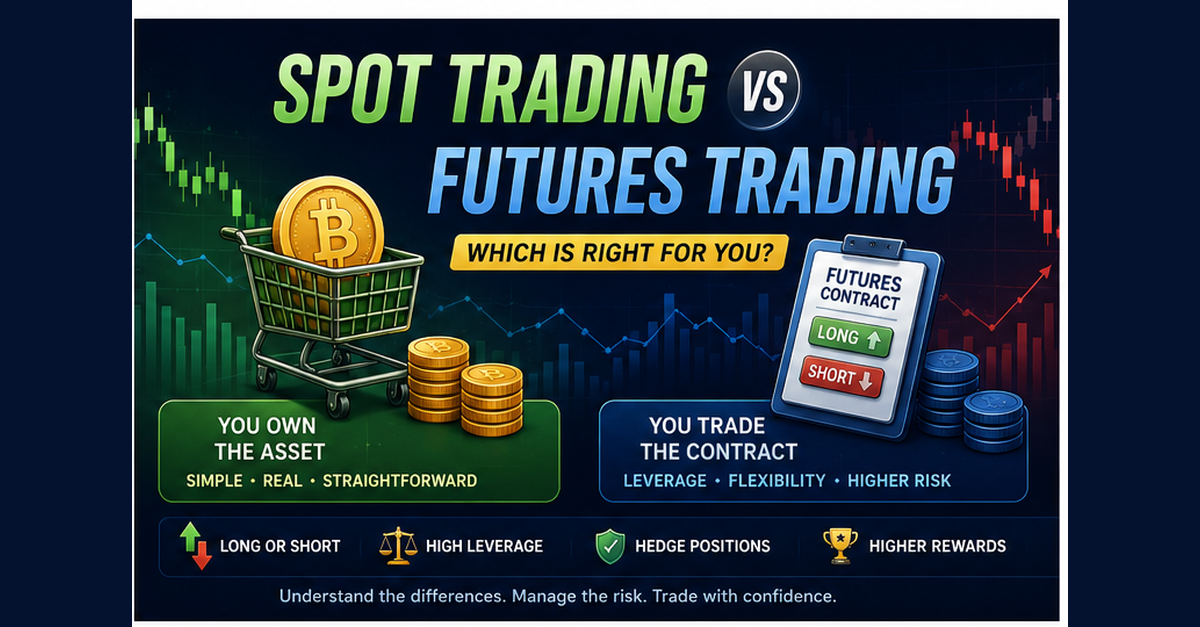
Trading financial markets offers several ways to participate in price movements, but two of the most common methods are spot trading and futures trading. Both can be used across cryptocurrencies, commodities, currencies, indices, and other financial instruments, yet they operate in fundamentally different ways.
Spot trading involves buying or selling the actual asset at the current market price. Futures trading involves buying or selling a contract whose value is linked to an underlying asset, usually with settlement or expiry conditions defined in advance.
Understanding the differences between these two approaches is essential because they involve different levels of ownership, leverage, complexity, cost, and risk.
WHAT IS SPOT TRADING?
Spot trading is the most direct form of market participation. A trader buys or sells an asset at its current market price, known as the spot price.
When buying an asset on the spot market, the buyer generally becomes the owner of that asset. For example, purchasing Bitcoin on a spot exchange means the buyer owns Bitcoin that can potentially be held, transferred to a wallet, or sold later.
In traditional financial markets, settlement may occur immediately or within a short settlement period. In cryptocurrency markets, asset ownership is usually reflected in the trading account as soon as the order is completed.
A typical spot transaction follows this process:
- The trader deposits funds into an exchange or brokerage account.
- The trader selects an asset.
- A market or limit order is submitted.
- The order is matched with another market participant.
- The asset is credited to the buyer’s account.
- The trader holds or later sells the asset.
Spot trading is generally easy to understand because profit and loss are based directly on the movement of the owned asset.
If a trader buys Bitcoin at $60,000 and later sells it at $66,000, the gross gain is $6,000 before trading fees and other costs.
OWNERSHIP IN SPOT TRADING
One of the defining characteristics of spot trading is ownership.
When purchasing an asset in the spot market, the trader usually owns the underlying asset rather than a financial contract representing it.
This ownership may provide additional options. A cryptocurrency purchased through spot trading may be:
- Held for long-term investment.
- Transferred to a personal wallet.
- Used for payments.
- Staked where supported.
- Used within decentralized finance applications.
- Sold at a later date.
However, ownership also creates responsibilities. Cryptocurrency holders must consider exchange risk, wallet security, private-key management, phishing, and asset custody.
SPOT TRADING AND LEVERAGE
Traditional spot trading normally involves little or no leverage. A trader purchasing $5,000 worth of an asset generally provides the full $5,000.
Some platforms offer margin-based spot trading, but ordinary spot trading is usually unleveraged.
The lack of leverage generally reduces the probability of rapid liquidation. If the asset falls in price, the trader still owns it unless the position was financed using borrowed funds.
This does not mean spot trading is risk-free. An asset can decline significantly or even become worthless. However, an unleveraged spot trader typically cannot lose more than the amount committed to purchasing the asset.
ADVANTAGES OF SPOT TRADING
Spot trading offers several advantages:
- Direct ownership of the asset.
- Simple profit-and-loss structure.
- No contract expiry in ordinary spot markets.
- No funding-rate charges on unleveraged positions.
- Lower liquidation risk.
- Suitable for long-term investing.
- Straightforward for beginners.
- Assets may be withdrawn into self-custody.
These features make spot trading attractive to investors who want to accumulate assets gradually and hold them over extended periods.
LIMITATIONS OF SPOT TRADING
Spot trading also has limitations.
A trader generally profits when the asset rises and is later sold at a higher price. Although assets can be sold or shorted through other mechanisms, ordinary spot ownership is naturally biased toward rising markets.
Capital efficiency is also lower because the trader normally funds the full value of the position.
For example, purchasing $20,000 worth of Bitcoin in the spot market generally requires $20,000 in capital. A futures trader might control the same notional exposure with a smaller margin deposit, although that leverage substantially increases risk.
WHAT IS FUTURES TRADING?
Futures trading involves contracts whose value is derived from an underlying asset. The trader does not necessarily own the asset itself. Instead, the trader holds a contractual position linked to its price.
A futures trader may take:
- A long position, expecting the market to rise.
- A short position, expecting the market to fall.
This ability to participate in both rising and falling markets is one of the main attractions of futures trading.
Traditional futures contracts often specify:
- The underlying asset.
- Contract size.
- Expiration date.
- Settlement method.
- Delivery or cash-settlement terms.
Cryptocurrency exchanges also offer perpetual futures, which have no fixed expiry date. Perpetual contracts use funding payments to help keep the contract price aligned with the spot market.
LEVERAGE IN FUTURES TRADING
Leverage is one of the most important differences between spot and futures trading.
Leverage allows a trader to control a position larger than the capital deposited as margin.
For example, with 10-to-1 leverage, $1,000 of margin may control a position worth $10,000.
If the market rises by 2%, the position may gain approximately $200 before fees. That represents a 20% return relative to the $1,000 margin.
However, if the market falls by 2%, the position may lose approximately $200, representing a 20% loss on the margin.
Leverage magnifies outcomes in both directions. It does not improve the quality of the trading decision; it simply increases exposure.
High leverage can cause positions to be liquidated after relatively small adverse price movements.
MARGIN AND LIQUIDATION
Futures positions require margin.
Initial margin is the amount required to open a position. Maintenance margin is the minimum amount that must remain available to keep it open.
When losses reduce account equity below the required maintenance margin, the broker or exchange may liquidate the position automatically.
Liquidation is designed to prevent losses from exceeding the available collateral, although in extreme market conditions losses may still be substantial.
Futures traders must therefore understand:
- Initial margin.
- Maintenance margin.
- Liquidation price.
- Available collateral.
- Cross margin.
- Isolated margin.
- Unrealized profit and loss.
- Risk limits.
A trader who does not understand these concepts should not use significant leverage.
LONG AND SHORT TRADING
Futures markets make short selling relatively straightforward.
A long position benefits when the contract price rises.
A short position benefits when the contract price falls.
This flexibility allows futures traders to:
- Speculate on upward price movements.
- Speculate on downward price movements.
- Hedge existing spot holdings.
- Trade market-neutral strategies.
- Exploit relative-value opportunities.
For example, an investor holding Bitcoin in a spot wallet may open a short Bitcoin futures position to reduce exposure during a period of uncertainty.
If Bitcoin falls, the spot holding loses value, while the futures short may gain. The hedge may reduce overall portfolio volatility.
FUTURES CONTRACT EXPIRY
Traditional futures contracts expire on specified dates.
Before expiry, a trader must:
- Close the position.
- Roll the position into a later contract.
- Accept cash settlement.
- In some markets, prepare for physical delivery.
Rolling a futures position means closing the expiring contract and opening a new position in a later contract.
The prices of different expiry months may vary due to interest rates, storage costs, market expectations, and supply-and-demand conditions.
Cryptocurrency perpetual futures avoid fixed expiry but introduce funding payments.
FUNDING RATES IN PERPETUAL FUTURES
Perpetual futures use funding rates to keep contract prices close to the underlying spot price.
Funding payments usually occur at regular intervals between long and short traders.
When funding is positive:
- Long traders generally pay short traders.
When funding is negative:
- Short traders generally pay long traders.
Funding costs can materially affect profitability, particularly for positions held over long periods.
A trade may move in the correct direction but still produce a disappointing result if accumulated funding charges are high.
SPOT TRADING COSTS
Spot trading costs commonly include:
- Maker fees.
- Taker fees.
- Bid-ask spread.
- Deposit or withdrawal fees.
- Network fees for cryptocurrency withdrawals.
- Custody or account fees on some platforms.
The cost structure is generally straightforward.
Once the asset has been purchased, an unleveraged spot position usually does not incur recurring funding charges simply for remaining open.
FUTURES TRADING COSTS
Futures trading may involve:
- Trading commissions.
- Bid-ask spread.
- Funding payments.
- Contract rollover costs.
- Exchange fees.
- Liquidation fees.
- Borrowing or financing charges.
- Slippage during volatile markets.
These costs can become significant for highly active or leveraged traders.
Profitability should therefore be evaluated after all fees, not merely from the difference between entry and exit prices.
RISK COMPARISON
Spot trading and futures trading have different risk profiles.
SPOT TRADING RISKS
- Market price may fall significantly.
- Asset may lose most or all of its value.
- Exchange may fail or restrict withdrawals.
- Wallet credentials may be compromised.
- Private keys may be lost.
- Liquidity may decline.
- Regulatory conditions may change.
FUTURES TRADING RISKS
- Leverage magnifies losses.
- Positions may be liquidated.
- Funding rates may reduce returns.
- Sudden volatility may create slippage.
- Margin requirements may increase.
- Contract prices may temporarily diverge from spot.
- Poor risk control may cause rapid account depletion.
Although futures trading can be efficient, its risk can escalate quickly.
PROFIT OPPORTUNITIES
Spot traders typically seek appreciation in the underlying asset.
A common strategy is:
Buy at a lower price.
Hold.
Sell at a higher price.
Spot trading is therefore commonly associated with investing, accumulation, and long-term portfolio growth.
Futures traders may profit from both rising and falling prices.
They may also use strategies involving:
- Trend following.
- Breakouts.
- Mean reversion.
- Hedging.
- Arbitrage.
- Basis trading.
- Spread trading.
- Short-term speculation.
This flexibility makes futures attractive to experienced traders, but it also introduces greater complexity.
SPOT-FUTURES ARBITRAGE
The relationship between spot and futures prices can create arbitrage opportunities.
Suppose Bitcoin trades at $60,000 in the spot market while a futures contract trades at $63,000.
A trader may:
- Buy Bitcoin in the spot market.
- Short the futures contract.
- Hold both positions until prices converge.
The trader attempts to capture the difference between the two markets while reducing directional exposure.
This is sometimes called a cash-and-carry trade.
However, the strategy still involves execution risk, funding costs, exchange risk, collateral requirements, and basis risk.
WHO IS SPOT TRADING BEST FOR?
Spot trading is generally suitable for:
- Beginners learning market mechanics.
- Long-term investors.
- Traders who want direct ownership.
- Investors accumulating cryptocurrency or other assets.
- Individuals who prefer lower complexity.
- Traders who want to avoid liquidation risk.
- Users who want to withdraw assets into self-custody.
Spot trading may be the more appropriate starting point for someone who is still developing trading discipline and risk-management skills.
WHO IS FUTURES TRADING BEST FOR?
Futures trading may suit:
- Experienced traders.
- Short-term speculators.
- Hedgers.
- Institutional participants.
- Traders with defined risk systems.
- Participants who understand leverage and margin.
- Traders seeking exposure to falling markets.
- Quantitative or algorithmic traders.
Futures are not automatically better simply because they provide leverage. They are appropriate only when the trader understands how the contract works and has a robust method for controlling risk.
RISK MANAGEMENT IN SPOT TRADING
Spot traders should still use disciplined risk management.
Useful practices include:
- Diversifying holdings.
- Avoiding overconcentration.
- Using secure custody.
- Defining invalidation levels.
- Avoiding emotional buying.
- Maintaining cash reserves.
- Researching asset quality.
- Limiting exposure to highly speculative tokens.
A spot position that is never reviewed can still produce severe losses.
RISK MANAGEMENT IN FUTURES TRADING
Futures trading requires stricter controls.
Professional risk-management practices include:
- Using conservative leverage.
- Setting stop-loss orders.
- Limiting account risk per trade.
- Monitoring liquidation distance.
- Using isolated margin where appropriate.
- Maintaining excess collateral.
- Avoiding overexposure to correlated positions.
- Reducing risk before major news events.
- Reviewing funding rates.
- Implementing daily loss limits.
The objective is not merely to maximize return. It is to remain solvent through normal losing periods.
SPOT AND FUTURES IN ALGORITHMIC TRADING
Algorithmic systems may operate in either market.
A spot-trading algorithm may:
- Detect long-term trends.
- Accumulate assets gradually.
- Rebalance a portfolio.
- Execute dollar-cost averaging.
- Trade mean-reversion opportunities.
- Route orders across exchanges.
A futures-trading algorithm may:
- Trade long or short.
- Apply leverage dynamically.
- Hedge portfolio exposure.
- Monitor margin continuously.
- Manage funding-rate risk.
- Execute market-neutral strategies.
- Close positions before liquidation thresholds are reached.
Futures algorithms require more extensive safeguards because errors may be amplified by leverage.
THE IMPORTANCE OF MARKET CONTEXT
The choice between spot and futures should not be based solely on expected profit.
Traders should consider:
- Market trend.
- Volatility.
- Time horizon.
- Capital available.
- Risk tolerance.
- Experience level.
- Liquidity.
- Trading costs.
- Need for asset ownership.
- Ability to monitor positions.
A long-term investor may prefer spot ownership. A short-term hedger may prefer futures. A professional trader may use both simultaneously.
COMMON BEGINNER MISTAKES
Common spot-trading mistakes include:
- Buying after extreme price increases.
- Holding low-quality assets indefinitely.
- Leaving large balances on insecure exchanges.
- Failing to diversify.
- Ignoring transaction and withdrawal fees.
Common futures-trading mistakes include:
- Using excessive leverage.
- Entering without a stop-loss.
- Ignoring funding rates.
- Adding margin repeatedly to a losing trade.
- Failing to understand liquidation.
- Trading emotionally after losses.
- Using the entire account as collateral.
- Opening several correlated positions.
These mistakes often arise from focusing on potential profit while underestimating downside risk.
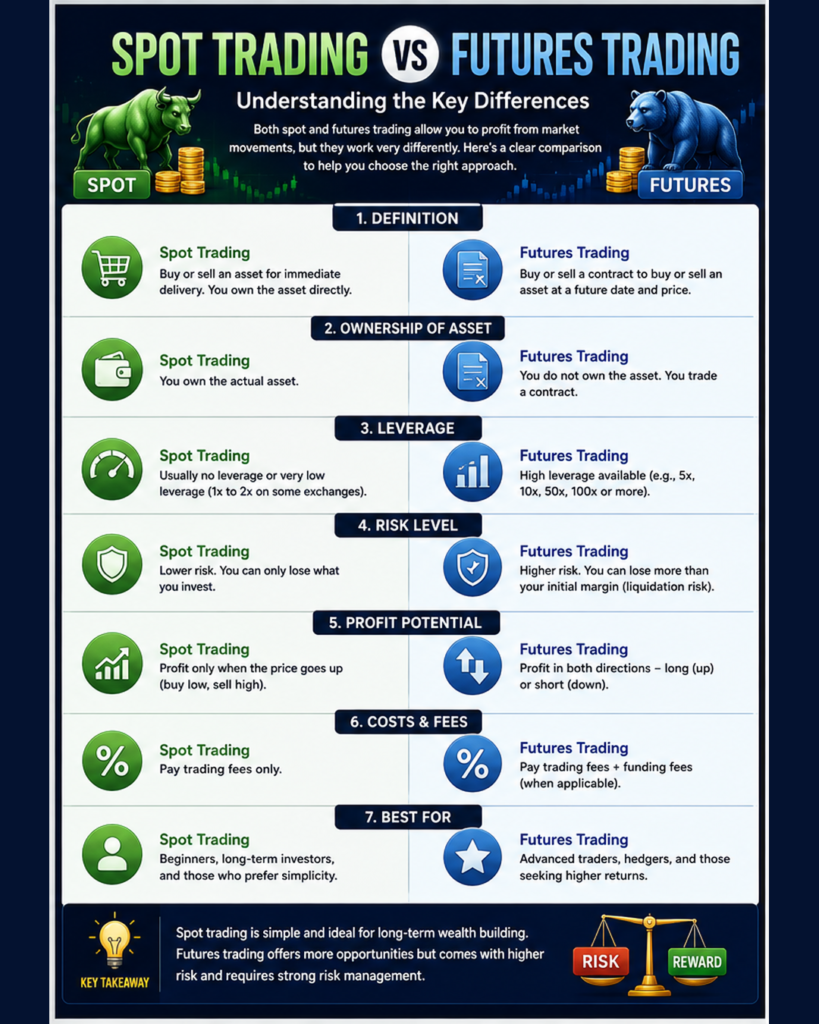
SPOT TRADING VS FUTURES TRADING: KEY COMPARISON
Spot trading:
- You generally own the asset.
- Lower complexity.
- Usually no leverage.
- Lower liquidation risk.
- Mainly benefits from rising prices.
- Suitable for long-term holding.
- Simple cost structure.
Futures trading:
- You trade a contract.
- Higher complexity.
- Leverage is commonly available.
- Liquidation is possible.
- Can profit from rising or falling prices.
- Useful for speculation and hedging.
- May involve funding or rollover costs.
CONCLUSION
Spot trading and futures trading are both valuable tools, but they serve different purposes.
Spot trading emphasizes ownership, simplicity, and long-term participation. It is generally easier to understand and carries less structural risk when used without leverage. It is well suited to investors who want to buy, hold, and manage actual assets.
Futures trading emphasizes flexibility, capital efficiency, hedging, and the ability to trade in both directions. It can offer broader strategic possibilities, but leverage, margin requirements, funding costs, and liquidation risk make it significantly more demanding.
Neither approach is universally superior. The right choice depends on the trader’s goals, experience, time horizon, strategy, and tolerance for risk.
The most important principle is to understand the instrument before using it. A trader should know exactly what is owned, how profit and loss are calculated, which fees apply, and how much can be lost.
Trading success depends less on choosing the most powerful instrument and more on using the appropriate instrument with discipline, realistic expectations, and consistent risk management.
No responses yet